A Small Bone, a Long Memory
A look at contemporary and historical use of Astragalus Bones and Runes

There is a certain feeling that arises when you hold an artifact.
I am not an archaeologist, and I do not mean “artifact” in the academic sense. I practice ancestral skills, and I look to artifacts as instructions rather than relics. When something is newly made in the old ways, it carries a presence that feels older than the moment of its making.
Imagine a backpack made entirely from materials you have foraged, hunted, processed, and assembled yourself—bark, sinew, leather, antler. It does not feel like a modern object. It is like remembering a pleasant memory long forgotten and marveling at the fact that it has returned.
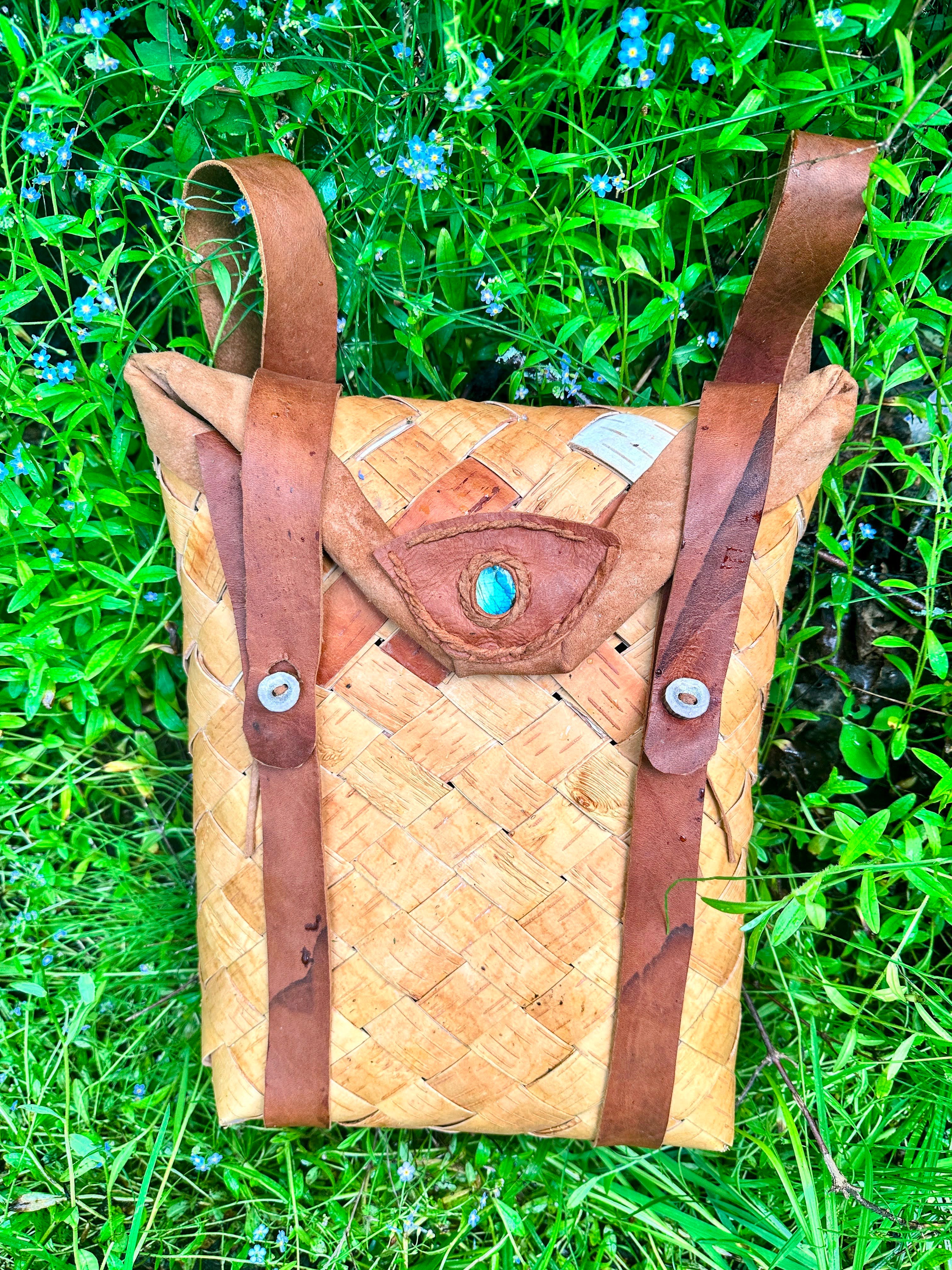
Working this way teaches you that materials are not neutral. Bark remembers the tree. Sinew remembers movement. Bone remembers weight and balance. Spend enough time making with these materials, and you learn how to listen.
It was through this way of noticing that astragalus bones entered my life. Astragalus bones—also called talus bones—come from the ankle joint of hoofed animals. I cannot pinpoint when I first learned about them. My curiosity may have been sparked by a mention of dice games among California Indigenous tribes. Long before that, I encountered them while wandering the woods, picking through deer skeletons left by coyote kills in the deep bottoms of glacial moraines.
Astragalus bones are ancient dice. Their distinctive shape allows them to land naturally on four stable faces, unlike the six-sided cube die, which is a later technological development.
Archaeological and ethnographic evidence shows astragali used widely across the ancient world: in Greece and Rome through astragalomancy, in the Near East and Levant, and throughout Central Asia, Mongolia, and Siberia, where the practice of shagai continues today. In these traditions, the bones were used for both games and divination, often without a strict boundary between the two. Each face carried qualitative meaning related to fortune, stability, movement, or loss. Greek writers such as Pausanias describe astragaloi used as lots, while living shagai traditions read the bones for seasonal luck, relational harmony, and conditions of fate rather than precise predictions (Kara, 2010).
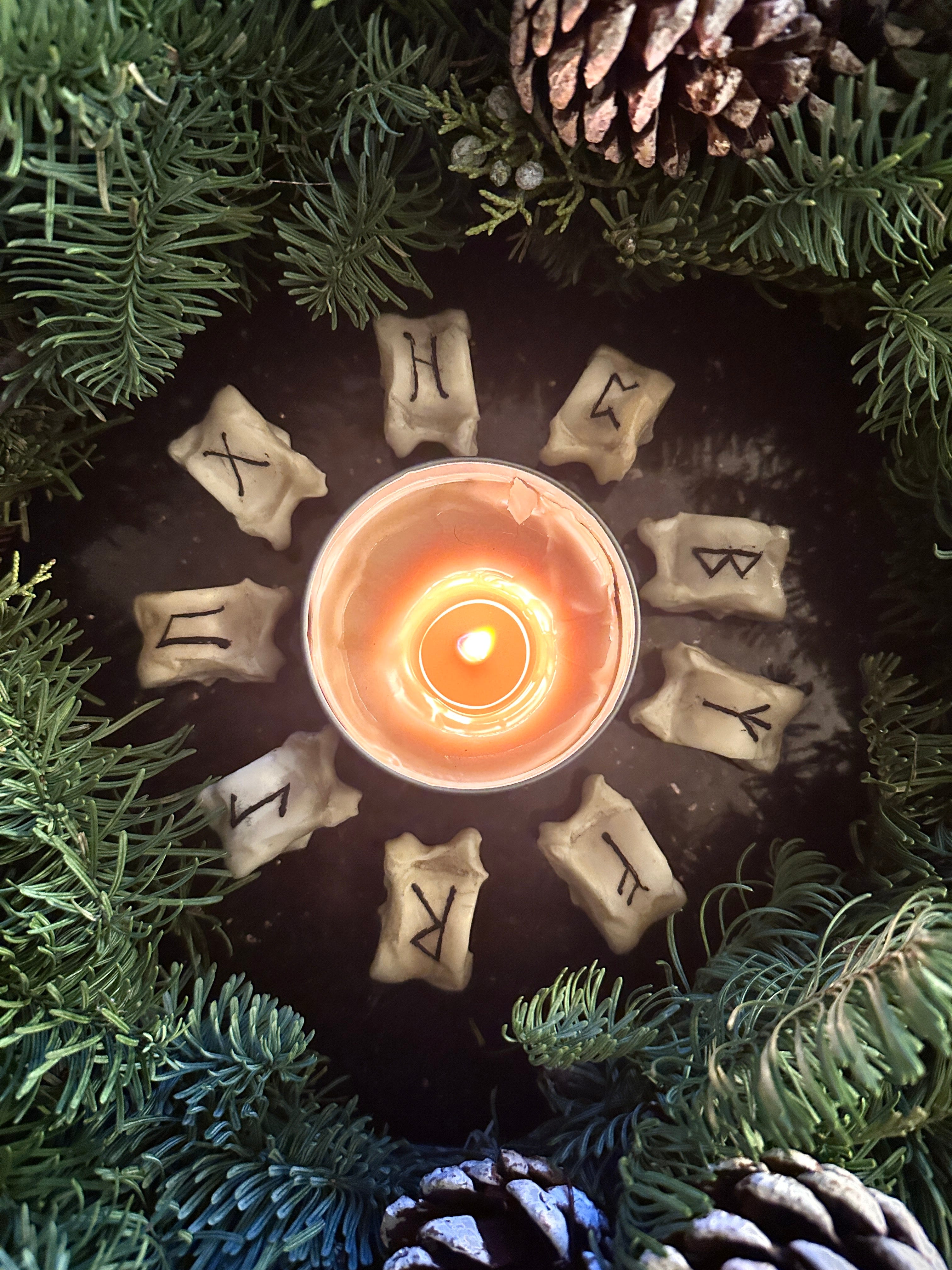
Across cultures, humans have cast lots—stones, sticks, shells, bones—to enter a relationship with fate. Bone casting, dice casting, and lot casting are often grouped under the term cleromancy: divination by chance (Flint, 1991; Haas, 1997). Here, chance is a revealing force.
Chance is often mistaken for disorder, but this is not how it appears in the natural world. Chaos theory shows that many systems are governed by rules, yet remain unpredictable because they are sensitive to countless small variables. The outcome is not always random, but it is not foreseeable either. Casting bones follows this same logic: the way they land is shaped by motion, surface, and timing, even if no one could calculate the result in advance.
Physics offers another useful metaphor. In theories that describe matter as vibrating potential rather than solid form, reality is understood as a field of possibilities that resolves into pattern through interaction. A tarot deck works the same way. Every card is possible until one is drawn. The moment of selection does not invent meaning; it brings one arrangement of many into focus.
I’ll be honest: I don’t really know how to play shagai, and I don’t have enough astragalus bones to assemble the large sets those games require. What I do have is a growing curiosity about contemporary rune casting. I’ve just finished watching Ragnar Lothbrok sack Paris in Vikings (season three), and once again I find myself captivated by Celtic, Germanic and Finno-Urgic history in Europe. It is mid-January,cold, gray and dark, the kind of season that invites inward listening. Sitting by the fire, I felt drawn not to replicate an existing system, but to imagine one shaped by winter, chance, and the particular bones before me.
What I’ve come up with is not an attempt to reconstruct a single historical practice, but rather to work in continuity with many older ones, drawing from rune lore, astragalus casting traditions, and animist approaches that understand divination as an act of listening rather than prediction.
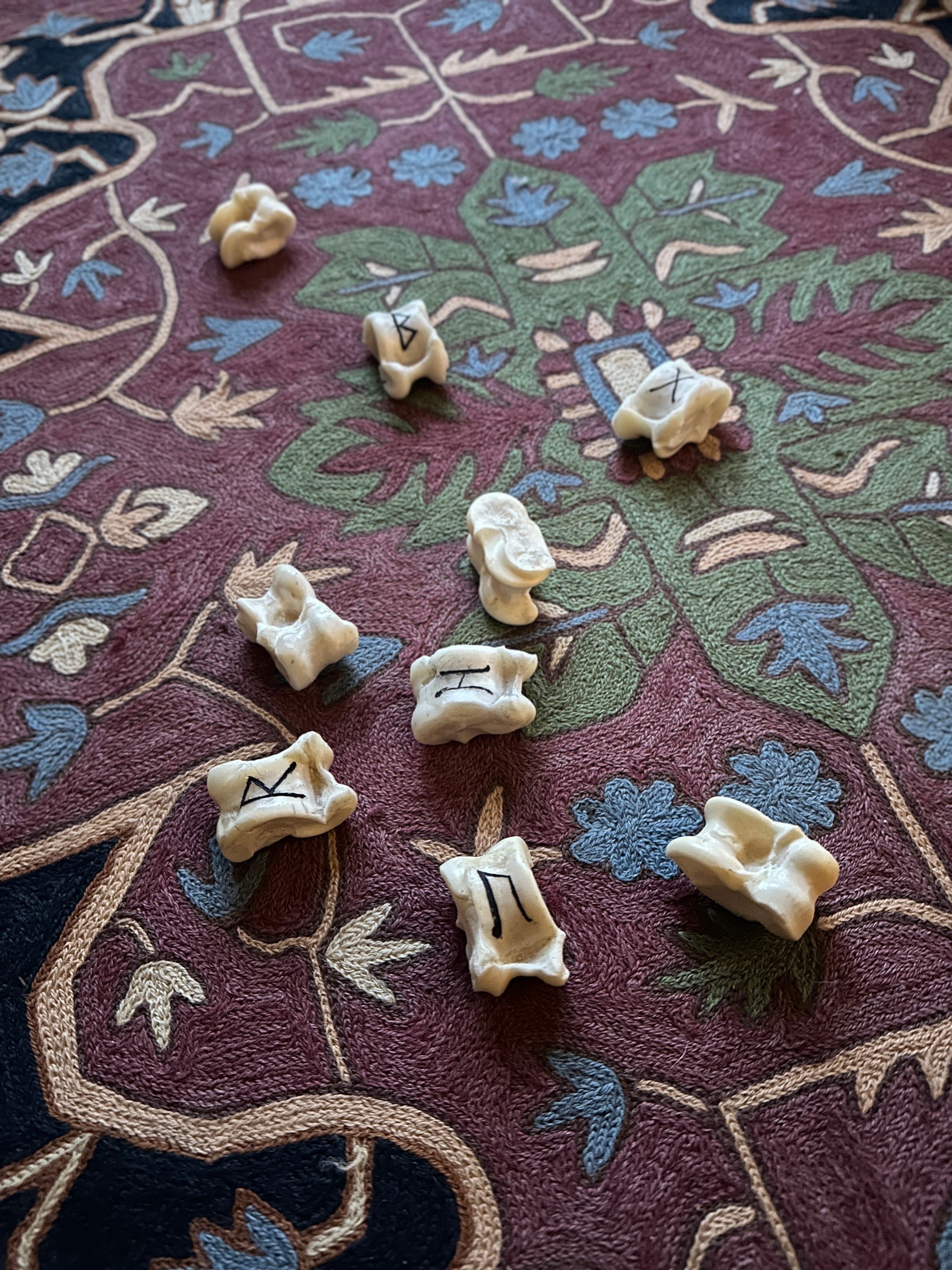
Astragalus Bones and Cleromancy
Runes

The runes of the Elder Futhark are often treated primarily as an alphabet. Historically, however, they also functioned as symbols of forces—conditions of life, states of becoming, and powers acting upon the human and more-than-human world. R. I. Page and Michael Barnes caution against treating runes as purely magical prescriptions, emphasizing instead their symbolic, poetic, and situational nature (Page, 1999; Barnes, 2007). Rather than a single, unified system of meanings, the historical record suggests a broad field of use shaped by context, intention, and material.
Of the several thousand surviving runic inscriptions, many are practical or even mundane: ownership marks, memorials, brief messages, or simple statements akin to “so-and-so made this.” An astragalus bone bearing a 5th-century runic inscription was found in an urn at Caistor St. Edmund, Norfolk, England. It reads ᚱᚨᛇᚺᚨᚾ (raïhan, “roe deer”) and is the oldest known runic inscription in England, suggesting ties to Scandinavian cultural influence, where the majority of runic inscriptions are found. (Findell, 2014). Other inscriptions gesture toward protection, invocation, or transformation—not in the sense of contemporary rune readings, but as inscribed prayers. In Bergen, Norway, many runes invoke Christian formulas in Latin, such as Ave Maria, raising questions about whether the carvers fully understood the language they inscribed (Findell, 2014). Taken together, the evidence points not to rigid definitions, but to a flexible symbolic language that moved easily between the ordinary and the sacred.
Explicit descriptions of how runes were cast are extremely sparse. The most frequently cited account, Tacitus’s Germania (c. 98 CE), describes carved lots that were drawn or cast and then interpreted according to circumstance, rather than through fixed meanings or standardized layouts. This lack of prescription suggests that meaning arose through situation and interpretation rather than codified systems.
Contemporary rune casting reflects this same logic. Modern practitioners generally understand rune work not as the recovery of fixed meanings from the past, but as the development of a relationship with symbols through use. Much of what is now treated as rune “meaning” derives from medieval sources such as the Old English, Old Norwegian, and Icelandic rune poems (9th–15th centuries), which preserve rune names and poetic associations rather than instructions for divination. These texts likely reflect older naming traditions, though it remains unclear how, or if, they were used historically for casting (Findell, 2014).
Today, rune sets are often handmade and personalized, shaped by available materials and lived context. Meanings are learned through repeated casting, journaling, and attentiveness to pattern over time.
In this way, contemporary rune casting can remain close to its roots—not through replication, but through responsiveness. Historically, runes were never standardized tools; they were carved into wood, bone, stone, or metal, adapted to local needs and individual practice. Modern approaches continue this pattern, even as the cultural context has shifted.
The system I designed works with a subset of nine runes rather than the full twenty-four. Historically, divinatory sets were often partial, shaped by material availability and situational need rather than completeness. The selected runes represent fields of experience rather than moral imperatives or fixed outcomes. They describe what kind of force is present, not what one should do about it.
Why Nine Bones?
With only nine astragalus bones, the system must still be capable of addressing the kinds of questions people actually bring to divination. Anthropological studies of cleromancy consistently show divination addressing survival, relational balance, disruption, and uncertainty (Flint, 1991; Haas, 1997). Comparative studies of divination systems show recurring concern with a limited number of life domains.
This system is structured around nine such domains:
Vital resources and sustenance
Strength and endurance
Movement, timing, and right order
Exchange and reciprocity
Protection and danger
Growth and gestation
Disruption and uncontrollable forces
Continuity, ancestry, and deep structure
Mystery, chance, and the unknown
These domains are not presented as universal truths, but as a functional cosmology—a practical framework that allows a small system to speak meaningfully across situations.
The Four Faces of Each Bone
Each astragalus bone presents four readable faces, and each rune in this system is expressed through all four. Rather than a simple upright/reversed logic, the faces are read as phases or states:
Solar – outward, active, manifest
Lunar – inward, receptive, hidden
Becoming – forming, shifting, in motion
Unraveling – dissolving, releasing
The solar and lunar aspects correspond to the two broad faces of the bone—one flatter and more stable, the other more rounded and containing. The narrow faces act as liminal thresholds, associated with transition and instability. Historical sources do not label faces as “solar” or “lunar”; this language is my own. However, the distinction between primary (broad) and liminal (narrow) faces is well documented in astragalus divination and shagai practice.

Casting as Relationship
Historically, bone divination depended on familiarity and repetition rather than fixed meanings. Diviners learned through pattern recognition over time, supported by memory, record-keeping, and embodied knowledge.
Meaning deepens through:
Repeated casting
Journaling outcomes
Attending to patterns across seasons
The bones are not neutral objects. As remains of once-living beings, they carry presence, weight, and history. This system approaches divination as a reciprocal relationship, not a tool for certainty. Many ethnographic accounts emphasize respectful handling, storage, and ritual context for bones used in divination, reinforcing their status as relational objects rather than instruments (Kara, 2010).
A Living System
This nine-bone rune set is intentionally open-ended. It is designed to be adapted, expanded, and refined through use. Meanings may shift over time, and that shift is part of the tradition rather than a deviation from it.
Divination here is not about foretelling the future, but about learning to read the present more honestly, with humility toward what cannot be known.
To bring old ways into contemporary life is not to freeze them in time. So much has been lost from my own lineage and from folkloric Europe. For me, respectfully adapting ancestral practices and traditions intentionally to fit my needs brings me into conversation with my humanity and revokes the dominant colonial culture that I am also a part of, although this has to be done with shadow work and care. Practices survive not because they are preserved intact, but because they remain useful—capable of speaking to the conditions of the present moment.
This astragalus rune set does not claim authority through age or accuracy. It is designed from attention: to material, to season, to chance, and to the subtle ways meaning arises through use. It is not a replica of something lost but a continuation of a way of making.
When we adapt ancestral practices thoughtfully, we do not dilute them. We place ourselves back into a long conversation between humans, land, and the unknown. Divination, in this sense, becomes less about answers and more about relationship: a way of remembering how to listen, how to notice pattern, and how to move with uncertainty rather than against it.
The bones do not speak because they are ancient. They speak because they are held, cast, returned to again and again. Meaning does not arrive fully formed. It accumulates, slowly and relationally, through use.
Bibliography
Barnes, Michael. Runes: A Handbook. Boydell Press, 2012.
Findell, Martin. Runes. J. Paul Getty Museum, 2014.
Flint, Valerie I. J. The Rise of Magic in Early Medieval Europe. Princeton University Press, 1991.
Haas, Heinrich. “Divination by Dice and Bones in the Ancient Mediterranean.” Journal of Near Eastern Studies, 1997.
Kara, V. Shagai: The Horsebone Game and Divination in Mongolia. Ethnographic Journal, 2010.
Page, R. I. Runes. University of California Press, 1999.
Thorsson, Edred.Runelore. Weiser, 1987.