

Table of Contents:
End Times Fascism- and How the “New Earth” Narrative is Co-opted
The Alchemical Processes of Grief and Rage in Personal and Social Transformation
I’m in a class titled Native American Resistance for Everyone through Chickadee Community Services, moderated by Chris La Tray, who is Little Shell Chippewa. He served as Montana’s Poet Laureate from 2023-2024.
I enrolled for many reasons, but mostly because—like many people right now—I am feeling the collective surge of rage, fear, and grief.
In class on Sunday someone asked for resources that were “nice” and “easy” to share, because they were having a hard time bringing these (honestly difficult) topics up with friends.
La Tray, in a candid and intimate conversation, said he’s done being nice.
I get it. La Tray tells many stories of other writers talking over him, misinterpreting him…people have been handled gently and still aren’t listening.
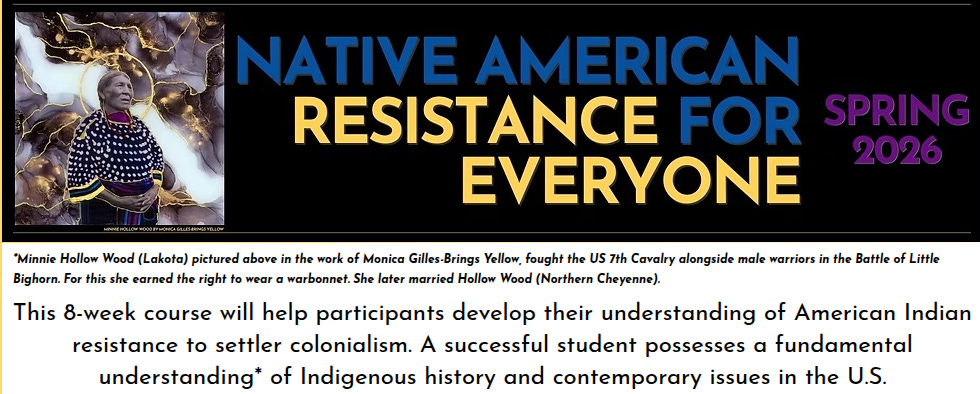
I’ve spent most of my academic life studying Indigenous worldviews, however imperfectly. I’m lucky to belong to a state that has written Indigenous Education for All into its constitution. It is a lifelong unlearning. I am deeply embedded in an extractive colonial culture that shapes the structures that I live in and take for granted as “normal”, meaning that it governs ways of thinking and behaviors: how I think about time, productivity, how I relate to people, how I relate to the land. We’ve been taught to believe that justice is something administered by institutions rather than practiced in relationships.
So when I hear people talk about “the world ending,” I think about how the world has already ended—many times over—for First Nations people.
End Times Fascism- and How the “New Earth” Narrative is Co-opted
What we are calling “collapse” is, for many, simply the long tail of an ongoing one.
And yet, here we are, watching the illusion crack. The wizard of Oz exposed. Institutions failing in ways that are now undeniable to the people they were designed to protect.
The question is not whether we are waking up, but what are we waking up into?
A spiritual friend recently sent me a video about “the collapse.” It was framed as ecological truth, dressed in the language of nature and inevitability. The message was that humans have violated natural law and that nature will now correct us.
It sounded ecological. It sounded spiritual.
It was also, on closer listening, a familiar story:
hierarchy is natural, suffering is inevitable, and mass death is simply a re-balancing.
This is what Naomi Klein calls “end times fascism”—the idea that climate catastrophe and social breakdown will justify abandonment, borders, extraction, and the sacrifice of entire populations.
Honestly her work remains one of the more eye-opening commentaries on our current times that I’ve found. Here is her interview with Democracy now:
Trump, Musk and End Times Fascism
If the future is already lost, then cruelty becomes rational. If collapse is inevitable, then solidarity becomes naïve. If we are in the “end times,” then democracy, mutual aid, and justice are luxuries we can no longer afford. Despair becomes a political technology.
And our anger, rightful, necessary anger, is redirected away from systems of power and toward each other, toward scapegoats, toward fantasies of purification and survivalism.
Anger as a Fire that Consumes
Our last class session was with Robert Hall, who works in Blackfeet language revitalization.
He talked about how unprocessed trauma keeps people in fight-mode. Limbic system activated. He explained how on the Blackfeet Reservation there’s a lot of quick, irrational conflict. And then he laughed and said—"we see that in the U.S. too. America has a lot of trauma.”
Maybe you feel that too. I do.
Let’s be honest, the system can handle all of our rage. All of it. We live in one of the most powerful countries in the world. What is our rage going to do against a government that has psy-oped the world? Rage is the point. The system profits off of our rage and then disassociation. That’s why it’s called rage bait. We can doom-scroll, rage-post, say ‘burn it down’ all day, but really we just rattle the cage.
Like that Smashing Pumpkins Song— ‘Despite all my rage I am still just a rat in a cage.’”
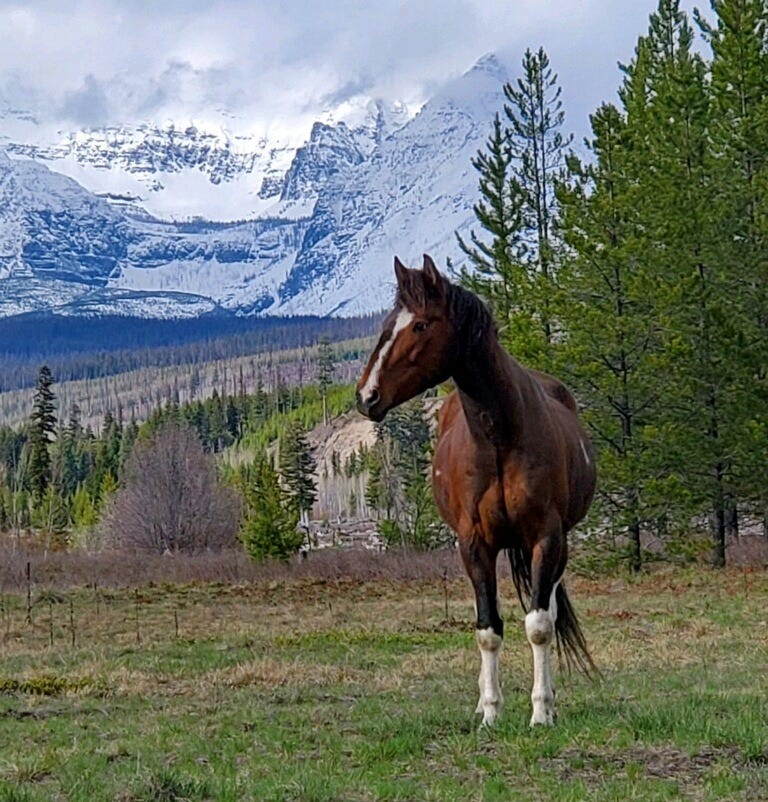
And we’re still perpetuating these myths. Notice that everyone talking about the “Year of the Fire Horse- go, go, go” is not Chinese and has very little lived experience with that knowledge, nor do they have a relationship with an actual living, breathing horse. If anything they’re adding fuel to an already Yang culture, to a house that’s already on fire.
The system does not fear our anger, but I do think it fears our grief.
The Alchemical Processes of Grief and Rage in Personal and Social Transformation
I’ve been thinking about this all alchemically.
Alchemy provides a language for transformation: describing how breakdown, purification, and reintegration are necessary phases in the making of something whole. Metaphorically, of turning lead into gold.
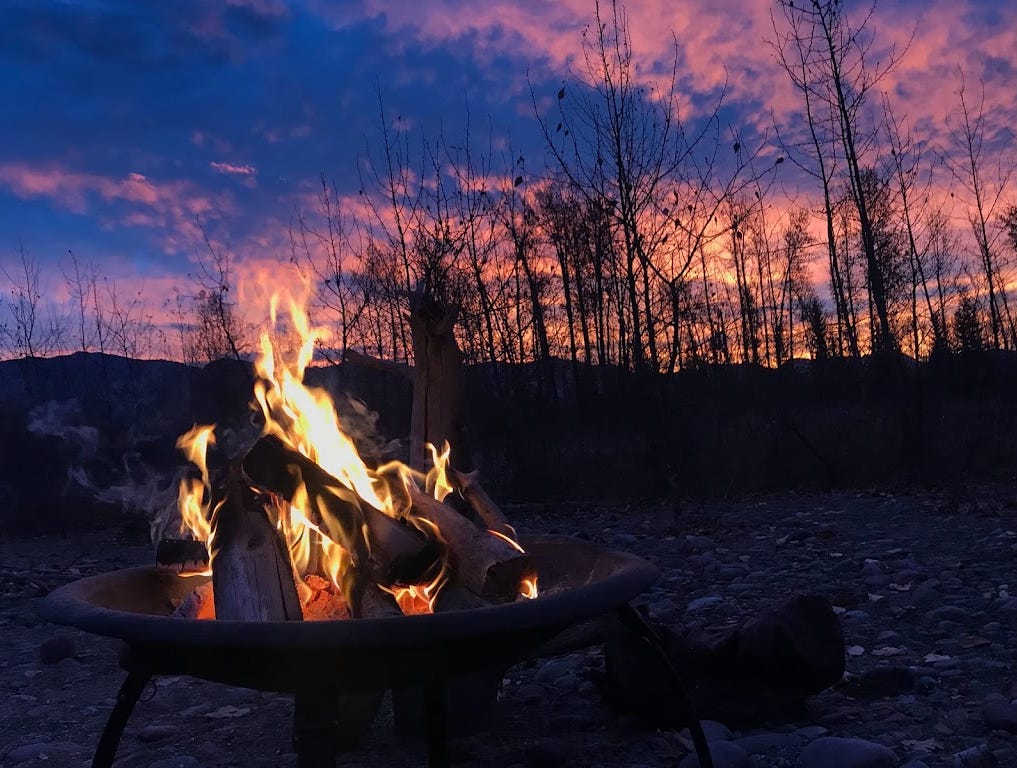
Anger is fire. It burns away the dross. It’s the first stage in transforming lead into gold. It’s necessary and powerful, but the vibe is low. It’s dealing directly with lead.
There’s 4 major stages of alchemy, and 7 operations within them. This stage is called Nigredo- Decay, rot, shadow, dismemberment of the false self. Everything that was taken for granted collapses. Confusion, anger, despair, confrontation with reality. Psychologically it deals with Shadow work. Loss of identity. Naming trauma. Rage.
It’s also known as calcination- burning and heating to ash.
Grief begins here but is not yet processed.
If we apply this idea to a social movement lens, this stage is the exposure of injustice, protest, rupture, refusal and naming harm.
However, this is where many movements get stuck. Rage is necessary, it breaks denial. But if there’s no container it burns people out or turns inward into factionalism. My case in point is how COINTELPRO targeted the American Indian Movement, the Black Panther Party, civil rights groups and anti-war organizers in the 50’s and 60’s. The stated goal by the FBI was to “expose, disrupt, misdirect, discredit, or otherwise neutralize” movements by intentionally creating internal conflict.
Sound familiar? How do the “Techno-Fascists” use their platforms to socially engineer us?
The second phase in the alchemical process requires water.
Albedo- the Water stage. Cleansing. Separation of what is essential from what is toxic. Mourning. Reflection. Slowing down. Psychologically it involves grief, integration, nervous system regulation, learning to sit with pain without discharging it as violence. It makes the next stages of alchemy possible- awakening, reorientation and then integration and embodiment.
Collectively this could look like truth-telling, listening, historical reckoning, relationship repair.
This is where people learn to stay instead of react. It’s also where positionality, land acknowledgments that are lived (not performative), and material accountability begin.
This stage builds the emotional literacy needed for long-term work. Without emotional and relational capacity, movements collapse before structural change can occur.

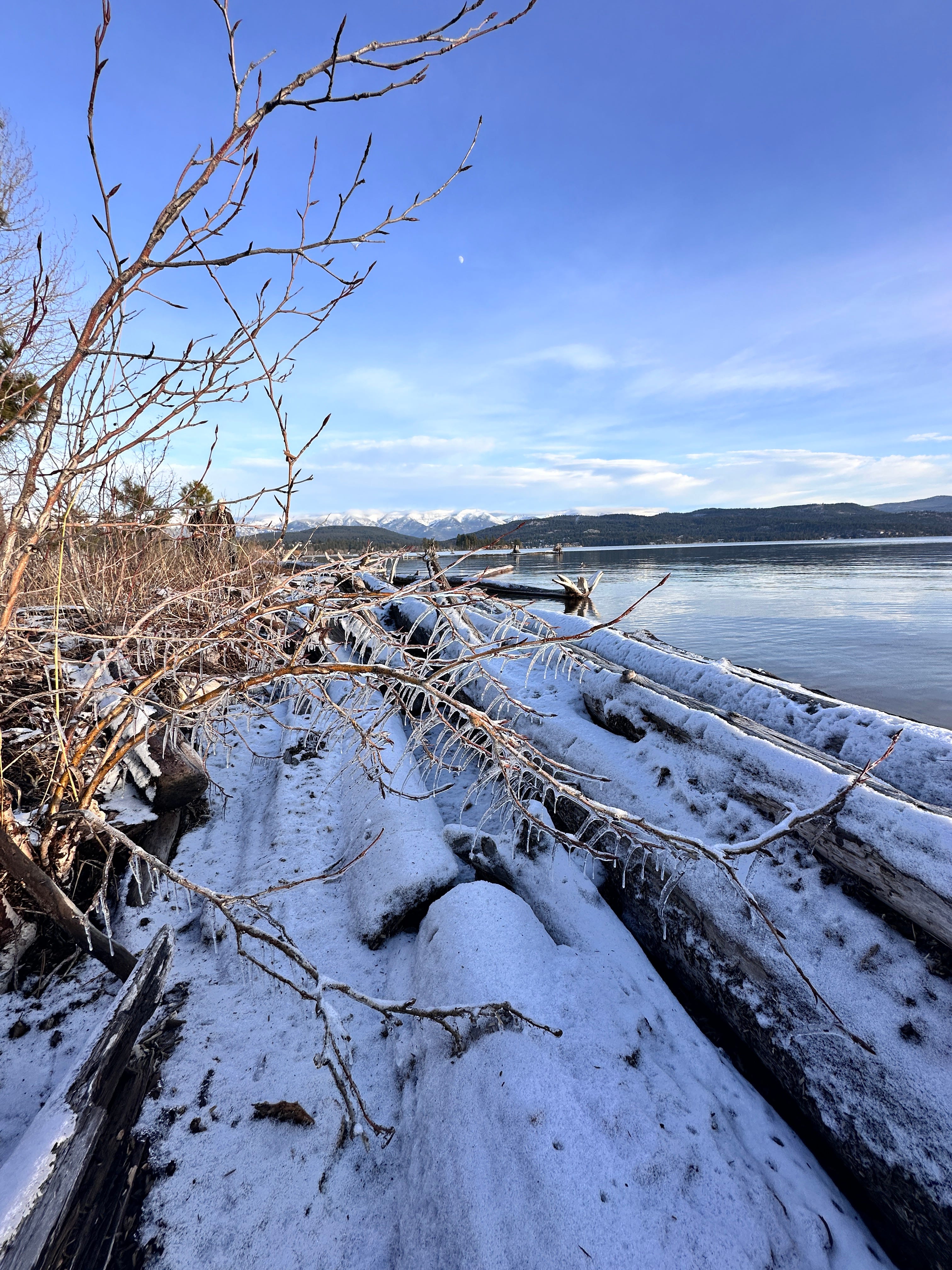
It’s still winter.
There’s snow on the ground. Water is everywhere.
We’re in a watery season. If you look at astrology we just entered Pisces season.
This is the grief season.
And if you tune in and listen to the land, grief is unavoidable.
The most powerful writing I’ve found on grief, indigenous grief, is in Leanne Betasamosake Simpson’s book Noopiming: the Cure for White Ladies. The opening chapter is a powerful metaphor for grief (if calling the narration a metaphor is even at all appropriate anyways) …In the book the main character is frozen in ice.
When we (and I mean generally white folks) are confronted with Indigenous rage, I urge us to remember the grief they and their communities have carried for hundreds of years. My first “awakening” one could say directly witnessed Indigenous grief, at the Baker Massacre Ceremony outside of Shelby, Montana.
Joanna Macy and the Intersection of Grief and Justice
Joanna Macy, one of my heroes, writes that anger is often the first doorway we walk through when we begin to see clearly. Anger tells us something is wrong—it is a boundary emotion, a signal of violated relationship. But it is not the destination. When we stay with it long enough, it opens into grief, which Macy describes not as something to get over, but something to move with. Grief is the natural response to loss when we are still connected to what we love.
Martín Prechtel teaches that we can only grieve as deeply as we love.
Another one of my teachers, Jon Young, understood that collective grief was also necessary. Jon Young is a naturalist, tracker, and founder of the 8 Shields cultural mentoring model, developed from decades of studying how intact land-based cultures transmit knowledge, identity, and belonging. I’ve worked in the 8 Shields model for about a decade now and have experienced first hand how grief processing can work as a social architect.
His central question was:
Why do some cultures produce deeply connected, resilient people—and others produce isolation and burnout?
Young led workshops designed around “Village building”- something that he called Cultural Repair. Within these workshops, collective grief was expected and planned for. With this model, grief is not personal therapy, but a communal regulation process.
When held in community, grief functions as a form of cultural technology rather than a purely private emotion. It metabolizes the shock of injustice, loss, and historical rupture so that people are not left cycling in isolation, where unprocessed grief hardens into rage, numbness, abuse or lateral harm. When we are held in community our capacity to experience grief expands. It helps us see each other for who we really are. Grief restores relational connection.
In many intact land-based societies, grief has structured roles, witnesses, and timelines; it restores belonging, re-sensitizes the body to relationship, and reorients individuals toward responsibility within the collective. Young observed in his research ( he spent a lot of time with the San Bushmen) that grief not only encompassed profound sadness, but also hysterical laughter. Grief restructures brain patterning when supported in community.
For social movements, this means grief is not a detour from political work but a precondition for it: without shared mourning and truth-telling, communities fracture under pressure. With it they develop the emotional coherence needed for strategy, mutual care, and long-term commitment. In this way, grief becomes a vessel that carries movements from reactive rupture toward grounded, durable transformation. Macy understood this well, and designed social gatherings centered around grief.
Let’s apply this idea through the four stages of alchemy: grief opens the body (Albedo), embodiment creates relational capacity (Citrinitas), that capacity allows for durable political work (Rubedo).
The numbness we are encouraged to cultivate—the irony, the detachment, the constant scrolling—that is what severs relationship. Culturally, we avoid grief at all costs. We medicalize it, privatize it, pathologize it, compress it into three bereavement days and a return to productivity.
I’ve facilitated grief circles with women, using Macy’s teachings, and even then some women have opted out because it’s “too heavy” -but the scale of loss we are living inside cannot be processed privately.
And so it leaks out:
as anxiety,
as rage,
as doom,
as dissociation.
Grief is Feral
Now even the wellness influencers are declaring, “the era of light and love is over,” as if grief were a trend cycle. But grief is not aesthetic, grief is feral.
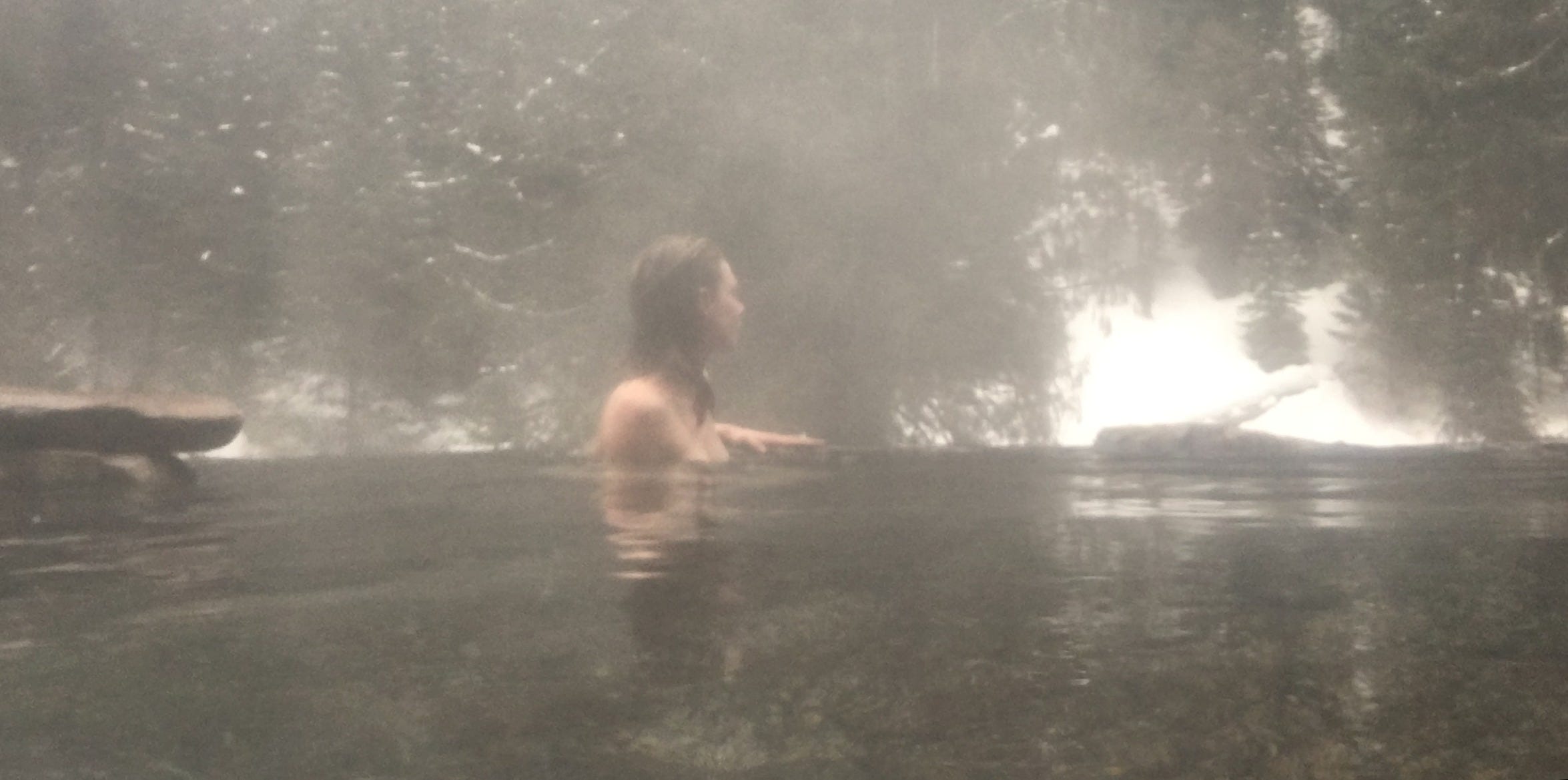
If you really let it in, it will dismantle you. It will undo your timelines, your goals, your sense of control. It will reorder your values without asking permission. It will make you care about things that do not make you money.
It is uncharted because it cannot be optimized, it is immeasurable because it is relational, it is wild because it refuses hierarchy. Grief does not ask which species mattered more. Grief does not calculate which community is most deserving.
It simply says “this mattered” and in saying that, it reveals what relationships we tend.
This is why grief is politically dangerous.
A culture that allows itself to grieve land cannot treat land as resource.
A culture that grieves stolen children cannot accept carceral systems as normal.
A culture that grieves languages cannot accept assimilation as progress.

Grief as the Antidote to Fascism
Grief makes extraction unbearable. Relationships are the opposite of fascism.
Fascism requires disconnection: from land, from history, from each other, from consequence. It thrives on speed, certainty, and hierarchy. It cannot function in a culture that knows how to sit beside loss without needing to dominate it.
This is why Indigenous survival is so threatening to collapse narratives. Because it demonstrates continuity.
It demonstrates that even after genocide, boarding schools, land theft, and criminalization, people are still here—speaking language, tending ceremony, revitalizing governance, raising children.
That is not apocalypse, that is endurance. And endurance is not passive. It is relational, adaptive, collective.
So when we move from anger into grief we are not becoming softer, we are becoming harder to manipulate.
Folkloric Practices for Grounding Grief
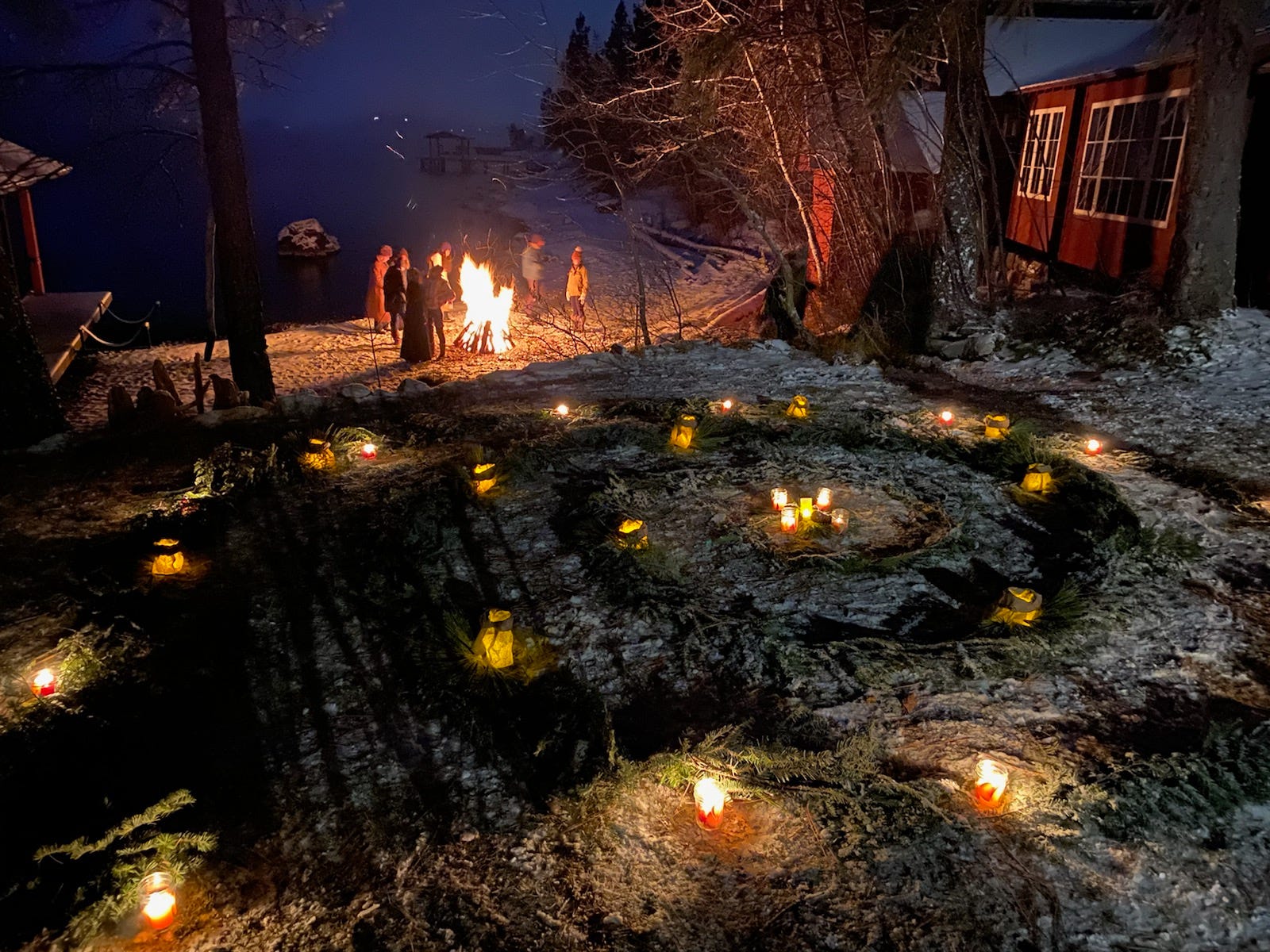
Water
Water as Relative
I find nature a powerful ally in grief processing. The land can hold grief in ways that other humans aren’t ready for. When we treat land as a relative, we can go to the land when we need a friend.
In working with albedo, the purification process in alchemy, I find cultivating a relationship with water is helpful. This can look like greeting a body of water when you meet them. I personally say a prayer of gratitude every time I cross a body of water- even on the highway. When I traveled to hotsprings in Mapuche territory in Patagonia,Chile, we had to cross a lake. My Mapuche guide instructed me not to touch the lake immediately. First there was a song. Then offerings. Then a greeting. The lake was a being that required ceremony.
Worldwide, there is a growing movement to recognize bodies of water as living entities with legal standing. The Whanganui River in Aotearoa has personhood. There have been efforts by tribal nations to advocate for similar recognition for rivers in what is now the United States. The book Is a River Alive? asks us to reconsider what it means to be in relationship with water rather than in control of it.
Water as Witness
Intuitively, I have always gone to water in the hardest moments of my life. Simply watching water can be a powerful meditation.
Different bodies of water hold different emotional textures.
A lake invites stillness. It asks you to sit, to listen, to feel how much is held beneath the surface. My relationship with Lake Superior holds an unfathomable amount of grief, I can’t quite explain it. There’s something about the vast expanse of lake and the icy cold water. I’ve stood among her icebergs in winter, mourning the loss of my grandmother, listening to the hollow sound of water carving caves in the ice. I’ve watched storms brew over her water in the summer, my heart with a friend who had just lost her brother.
Running water is different. If your mind is already racing, a river can feel overwhelming—too much motion, too much sound. But if you stay long enough, if you let your breath find the rhythm of the current, the water begins to carry some of the excess thinking away. And of course there’s the ions too, that can help boost mood and promote a sense of well being.
Rattlesnake Creek in Missoula is an old and familiar friend. In the same way the water rushes down the mountain, I find that it rushes through my mind- moving the boulders and logs and polishing the edges of my heart smooth.
In Peru I needed to cultivate strength and a sense of myself. I would stand underneath waterfalls, leaning into the rushing water beating against my back.
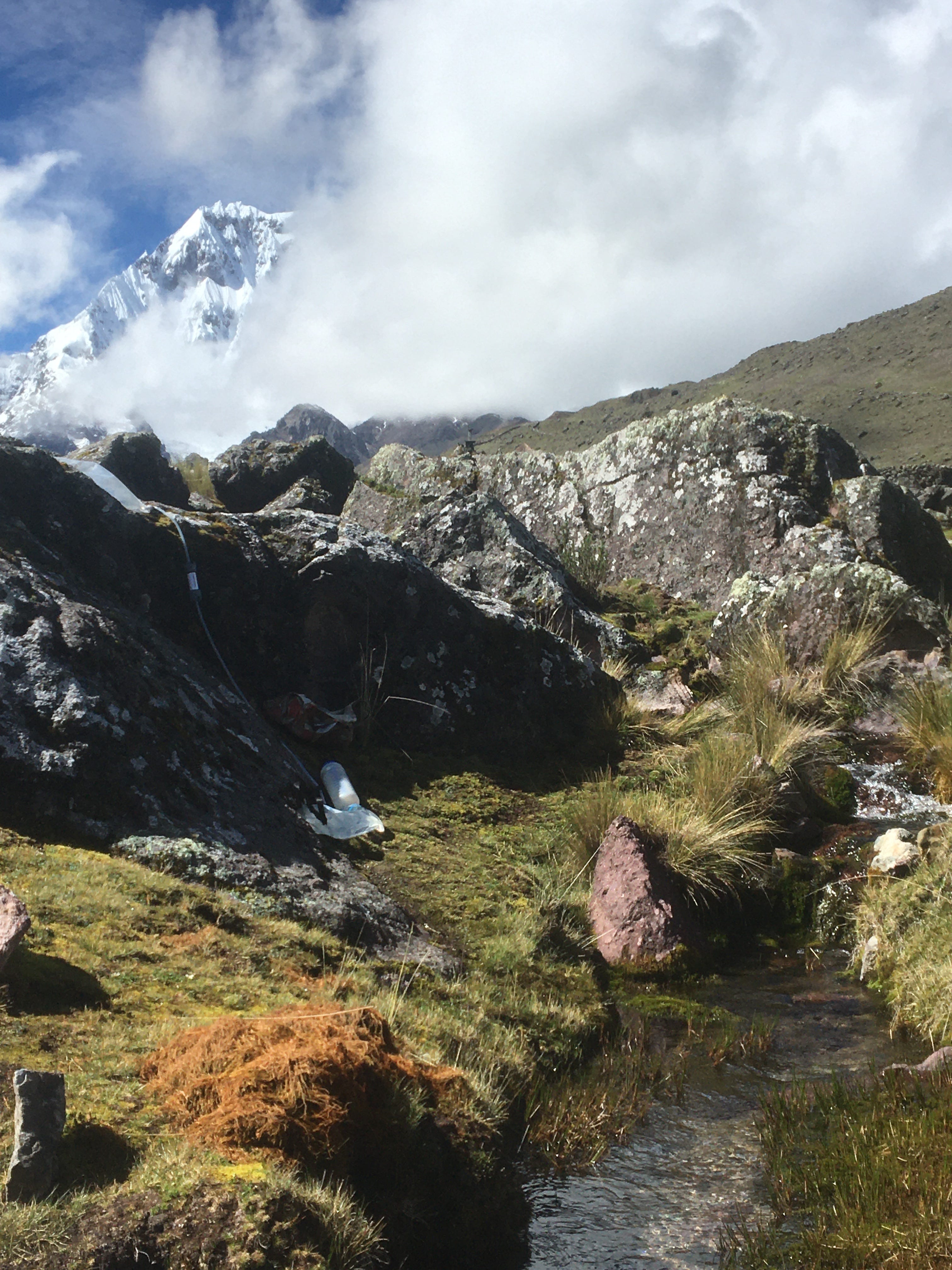
Something about the flow of moving water gives grief somewhere to go. There’s something about the darkest depths of a lake that can hold the deepest longings in your soul.
Baltic Folk Rituals
In Baltic folk practice, water is often used to soothe states of agitation, fear, or what we might now call nervous system overwhelm. One traditional action involves slowly ladling water, sometimes over the hands, sometimes into a basin, sometimes onto the earth, while speaking quietly or remaining silent. The emphasis is on repetition, rhythm, and cooling. We can think of this as a somatic practice.
In Latvian folk belief, water gathered at specific times, like morning dew, spring water, water taken before sunrise, was considered especially potent for calming and clearing. The act of handling water deliberately, rather than splashing or rushing, was itself part of the medicine.
There are also traditions of washing the face or hands three times, or pouring water across thresholds to release what should not be carried into the home. In some accounts, water is poured while naming what is being let go.
What is important in Baltic contexts is that water is relational and animate.
For me, this resonates with grief work because anger dysregulates the body. It creates heat, pressure, and looping thoughts. The repetitive motion of ladling water gives the mind something to follow that is not the grief story itself.
Stone
One of the most enduring practices I’ve learned from Joanna Macy is the building of grief cairns. I have used this practice as a guide, with teenagers and women’s circles, and I’ve been guided into this practice in fasting ceremonies.
Joanna Macy speaks about grief needing form, needing containers that allow it to be expressed collectively. One of the practices she offers is the building of grief cairns—small stacks of stones where each stone represents something mourned.
A species.
A place.
A relationship.
A version of yourself.
A future that will not happen.
You place the stone down. You say it out loud or you don’t. You let the weight register in your hand before you release it.
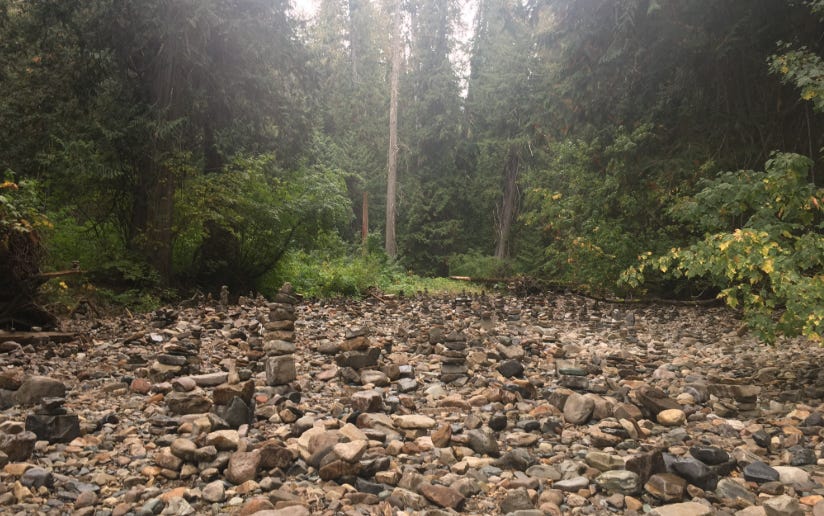
I have found that stacking stones externalizes what otherwise stays lodged in the chest. It makes grief visible without making it a spectacle. It creates a temporary monument that can return to the land without becoming a permanent claim.
The impermanence is important.
Death Ceremony
I participated in a four-day, four-night fast with the Animus Valley Institute as part of a week-long immersion in grief work. A death ceremony. During the fast my guides instructed me to build a wall from stone. Each stone represented a way I had been hurt.
This worked for a while, until I ran out of stones. Spontaneously, I began placing stones for the ways I had hurt others.
That shift changed the entire structure. The wall stopped being a record of injury and became a field of relationship. Grief moved from something that had happened to me into something I was accountable within. As I mature and come to terms with my own pain, I realize that in order to heal from the past, the parties involved must relinquish their side of the story.
Grief cairns are not about fixing anything. They are about witnessing what has been lost and what we are responsible to now.
Teenage Rite of Passage
I have facilitated this practice with teenagers in rites-of-passage contexts. In one ceremony we asked each teen to choose a stone that represented their grief and carry it up Nassukoin, the tallest mountain in the Whitefish range, in silence. Silence was a ritual boundary rather than a punishment; it created a container where no one had to perform their pain for others and we needed the kids to really focus on what they were carrying.

Not everyone summited. Staying behind with those teens taught me as much about grief as the cairn itself. Grief is not a summit experience.
In later years I witnessed the stacking of the cairn and the power of this ceremony. For those teens the cairns marked their sorrow of stepping into adulthood. They were cognizant of a threshold- of a childhood now only a memory for them. As guides, we trusted in the power of witnessing, the bonds of friendship in the group, and the nature Connection practices we facilitated, to alchemize their grief. When we build a cairn with other people it becomes a form of solidarity that does not require agreement, only care.
Women’s Circle and How Our Hands and Hearts Transform Grief
In a women’s circle, I instructed everyone to sit with Flathead lake, meditate on their grief, and ask for a stone. We then wet-felted wool around the stones. Through water, friction and warmth we encased their sadness in a soft layer of wool. Hair and fiber have long been vessels for grief in many cultures. Once the stones were encased in felt, we cut them out to create a pouch: a soft and furry amulet holder. The stones were then placed together in a cairn and the grief was shared across the circle. What struck me was how often the size and shape of the chosen stone seemed to mirror the grief the holder carried.
That is the intelligence of this practice: the body knows what it is holding long before the mind can articulate it.
Ancestors
Healing Robe Ceremony
Years ago I walked into a circle with a buffalo robe laid out on the ground. My small group was to participate in a healing blanket, or robe ceremony, and I was the one to be wrapped in the buffalo robe. The practice draws from several different traditions that have sometimes been brought together in inter-tribal or cross-cultural healing spaces. There isn’t one single universal name for the ceremony, and the specifics vary a lot depending on who is holding the practice. A Black woman from the Southern U.S. in our group understood the ceremony.
I will explain my experience and the knowledge I gained from this particular, individual experience, and how it relates to my understanding of how grief work intertwines with ancestor work.
As we stood in the circle our guide explained what we were to do, and why we were doing it. I was to be wrapped in the buffalo robe. The other people in our group would walk in a clockwise circle around me and cry their grief for the destruction of the natural world. Their wailing was intended to call the ancestors into the space for healing. To aid in the ceremony, participants took a shot of vodka. Understanding my personal lineage and ancestral trauma, I politely declined the vodka.
The buffalo robe felt like the best hug I’ve ever had. Warm, enveloping, safe. It evoked a bodily memory older than language, something like the feeling of being in a cave or deep shelter. People started crying. I remember intense feelings of grief welling up in me: despair for their pain and suffering and also an incredible sensation of love. If you’ve experienced magic mushrooms, perhaps you know what I’m talking about. This was a full-bodied, relational sensation of connection rather than an altered state; I was completely sober, yet it carried the clarity and depth that people sometimes associate with entheogenic experiences.
I understand that immense love to be the ancestors responding to our group’s collective grief.
Keening and Song
Across many cultures, grief is expressed in sound. Keening, wailing, and communal song function as technologies of the body that move sorrow through breath, vibration, and rhythm. In Irish traditions, keening created a sonic container where the bereaved did not have to hold their grief alone.
Keening was a recognized and skilled role within Irish society. The bean chaointe—the woman of the keen—served as a ritual grief specialist who gave voice to the loss on behalf of the entire community. She was often invited to wakes and funerals, sometimes compensated for her work, and expected to know the genealogy, stories, and character of the person who had died. Through improvised poetic lament she named the dead, called their ancestors, praised their deeds, and articulated the rupture their passing created. In doing so, she carried cultural memory at the threshold between life and death.
The structure of a keen created a container for grief. Moving between chant, speech, and wail, it synchronized breath and emotion across those gathered. The keener held the intensity so that others could join without becoming overwhelmed, redistributing the weight of loss across the social body. In this way keening functioned as communal nervous system regulation long before we had language for such a thing: it allowed grief to move, to be witnessed, and to reintegrate the community after rupture.
The suppression of keening in the eighteenth and nineteenth centuries, under both ecclesiastical pressure and colonial regulation, represents the loss of a relational technology for processing grief. When communal lament was replaced with privatized mourning, individuals were left to carry sorrow alone, and the social function of shared emotional release diminished. Remembering keening is therefore not an exercise in nostalgia but a recognition that grief was once vocal, collective, and structurally supported.
Contemporary research echoes what traditional cultures have long known: when people sing together, heart rhythms and breathing patterns begin to synchronize, creating a physiological sense of safety and belonging.
Play and Nature Connection
A part of grief work can be lineage work. For many of us, this is where the root of most personal grief resides. My relationship to ancestors has not come through genealogy charts or archives, but through landforms.
At Loughcrew Cairn T in co. Meath, Ireland, my mother and I climbed over the portal stone and into a neolithic passage tomb where a small group of German pagans were singing and drumming inside the chamber. They invited us in. Outside, Catholic school girls in uniforms ran up and down the mound, laughing, climbing, turning the ancient tomb into a playground.
It was one of the clearest expressions of continuity I have ever witnessed: ritual and recess happening at the same time. The sacred was not separated from the everyday. The dead were not separated from the living.
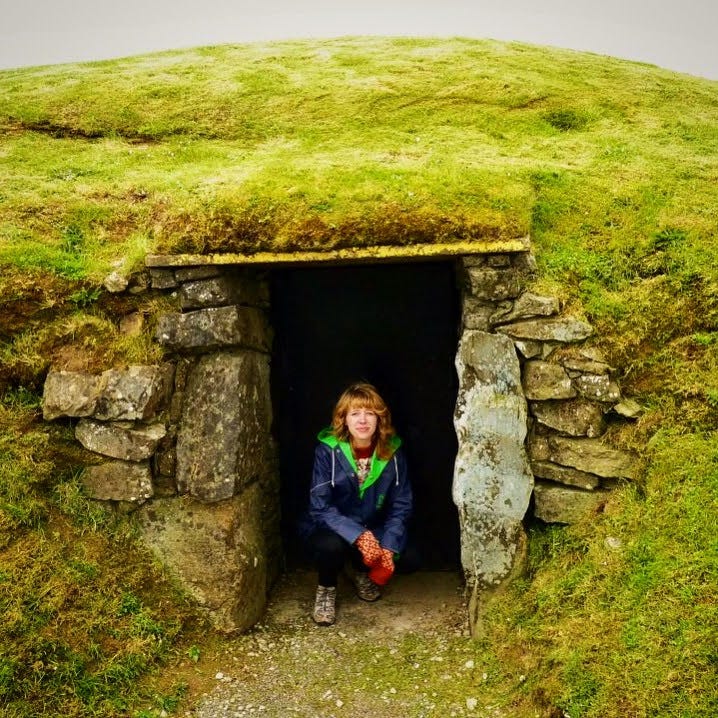
As adults we tend to approach grief and ancestry with a kind of heaviness, as if reverence requires solemnity. But children understand something we forget: care and play are not opposites.
I learned this while teaching outdoor education to young children. Through free-play, I discovered the joy of fairy houses. I was particularly moved by how these children treated their fairy houses with so much care. They would find the most precious treasures and arrange them so delicately: tiny offerings—feathers, petals, bits of moss—were arranged as if the fairies truly lived there.
Reading Max Dashu’s Witches and Pagans: Women in European Folk Religion later, I found language that resonated with what I had witnessed. In Irish and Scottish Gaelic tradition, the beings that English later called fairies are known as the Aos Sí and the Sìth—names that are inseparable from the landscape itself. The word sí/sìth refers to a mound, hill, or ancient earthwork, often places of burial and deep time. These were understood as inhabited sites, thresholds where the human world meets what is older and unseen. To speak of the “people of the mounds” is to acknowledge a cosmology in which land holds memory: the ancestors, their presences, and their stories dwelling within the earth. From this relationship emerges the enduring association in folklore between burial mounds, the dead, and the hidden folk.
I began making a small dolmen form as a fairy house-stacking three stones and a capstone, a miniature megalith -as a personal grief practice shaped by what I had learned from land, from children, and from story.
I would wash the stones with water, as one washes a body. This was long before I was aware of the Baltic water rituals. I would leave small offerings inside my mini dolmen: a flower, a chocolate, a lock of wool.
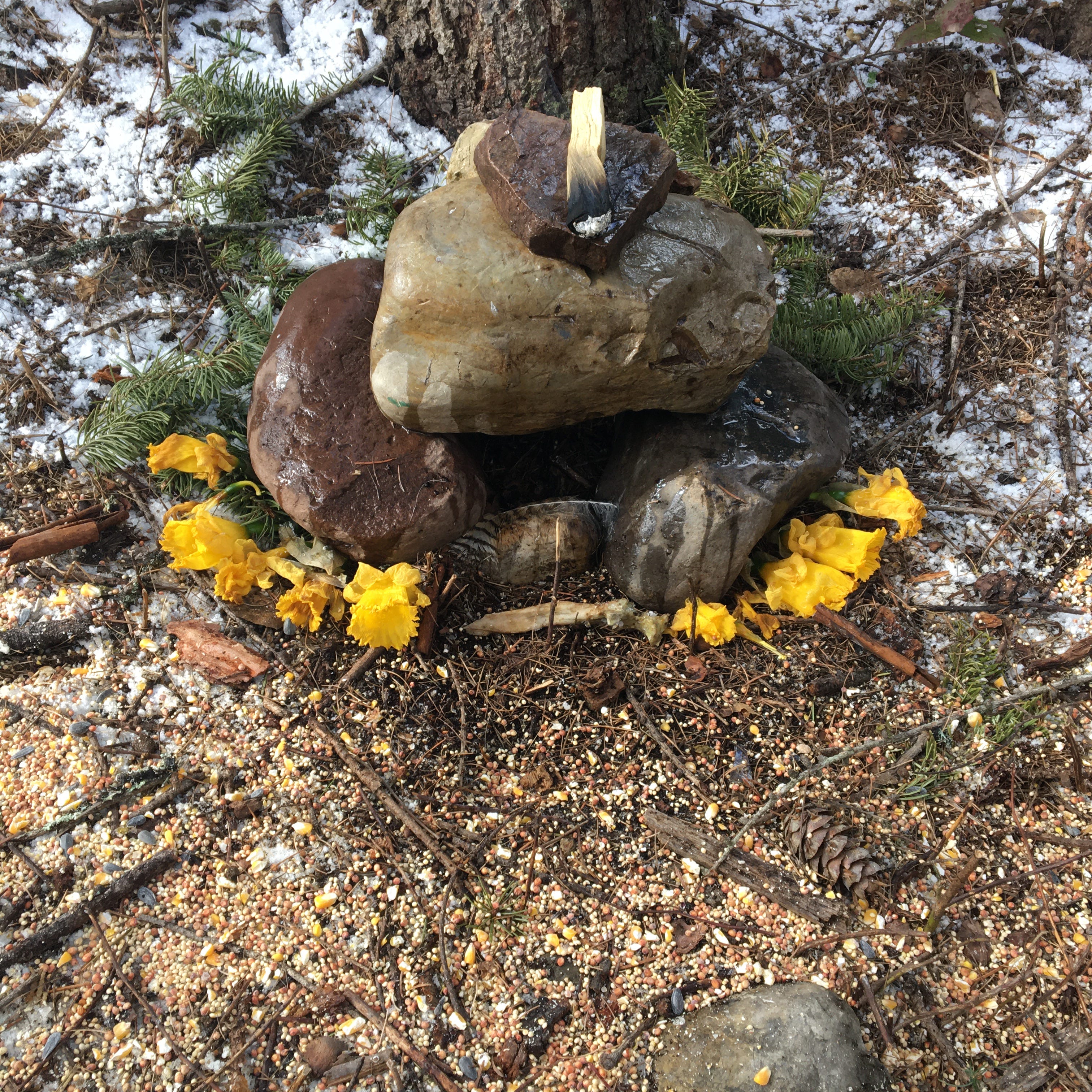
In play therapy, we understand that children process what they cannot yet speak through arrangement, repetition, and miniature worlds. A child places a stone, a leaf, a feather with great deliberation. They build, they undo, they rebuild. Nothing is permanent, but everything is meaningful. The scale makes the feeling manageable; the act of making gives form to what is otherwise diffuse in the body.
When my grandmother died I constructed this fairy house for her:
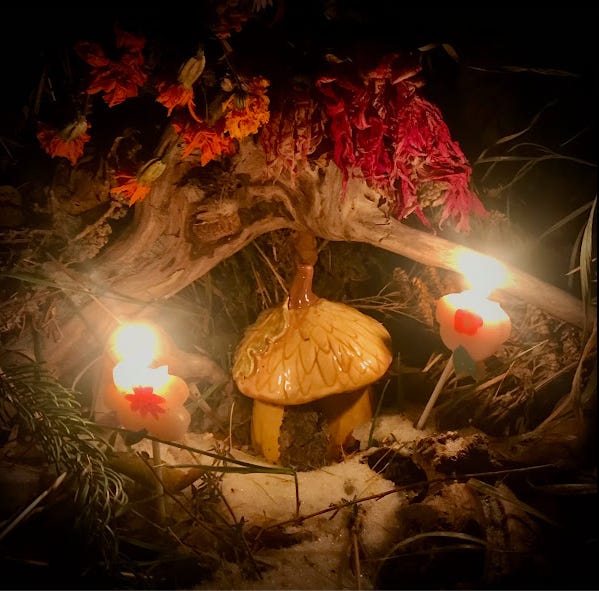
Seen this way, cairns, fairy houses, and small offerings externalize relationship so it can be touched, moved, and shared. They allow grief, curiosity, and reverence to coexist without needing to be explained.
In Conclusion- Parting Ways
These practices make a grammar for grief.
Water teaches us to move through our emotions fluidly, and stone teaches us to hold our emotions without collapsing.
If anger is the fire that shows us what is wrong, grief is the water that keeps that fire from consuming everything. Grief slows us down enough to remember relationship. It returns us to accountability. It asks: what do we love enough to protect?
A people who know how to grieve together cannot be easily divided.
A people who know how to sit beside loss cannot be easily manipulated by collapse narratives.
A people in relationship with land cannot be convinced that extraction is inevitable.
Grief reorganizes value. It makes certain kinds of work impossible: work that requires us to ignore suffering, to treat land as dead, to treat each other as expendable. And it makes other kinds of work unavoidable: mutual aid, language revitalization, tending water, raising children who know where they belong.
This is why grief is dangerous to fascism: It restores memory and it restores relationships.
Not apocalypse.
Continuity.
We are not at the end.
We are at a threshold.
Winter is the season where water holds its breath beneath ice.
When illusion melts, what remains is relational responsibility: to each other, to the land, to the futures that are still possible.
Brilliant post! Embracing and sharing grief honors our humanity and relationships with the world. Sharing the weight of shared grief is truly a path to healing and love for us individually and collectively. This is profound wisdom you've shared. Thank you!
"As adults we tend to approach grief and ancestry with a kind of heaviness, as if reverence requires solemnity. But children understand something we forget: care and play are not opposites." As a veteran middle school teacher I agree 100%. The heaviest things often need a bit of ridiculousness to help us engage instead of averting our eyes.