
The behemoth spruce tree lay mute in a slow and tedious death. Water quivered beneath scaly bark. The root ball towered overhead, severed from the soft earth, umbilical roots drying crisp in the sun.
We were guiding a group of teens that day, at the base of Big Mountain in Whitefish, Montana. Wandering in the intoxicating warmth of a spring day. Thaw pooled in the spruce forest, and the trees grew fat suckling the snow melt. Protected by an old homestead property, they were spared from the ambitious blades of Stump Town and the Great Northern Railway.
The tree could have been hundreds of years old. They don’t grow as fast in the Rockies as they do on the coast. The top of the trunk from the ground met my breast. My co-teaching partner climbed the log to gain purchase on the bark.
His knife blade pressed through scaly bark, then slit the pale flesh beneath. There’s a secret smell released when something is cut open. The soul escaping, perhaps. Spruce resin mixed into spring sunshine, adding sweetness to the acrid smell of skunk cabbage.
Lifting the bark at first with the blade, he then slid his hand into the tight pocket where phloem clings to heartwood. He had carpenter’s hands, rough from timber framing, and this task required a tedious and patient strength. We gathered, transfixed, working the bark for a good hour or so.
A thin film of sticky resin coated our hands. Dirt cased them in. We dug through the bare ground exposed by the root ball, pulling tendrils of roots from the ground. I taught the kids how to clean the root bark while my co-lead peeled a few more panels from the tree’s body. Returning to our base, we sat in patches of grass stitching our baskets.
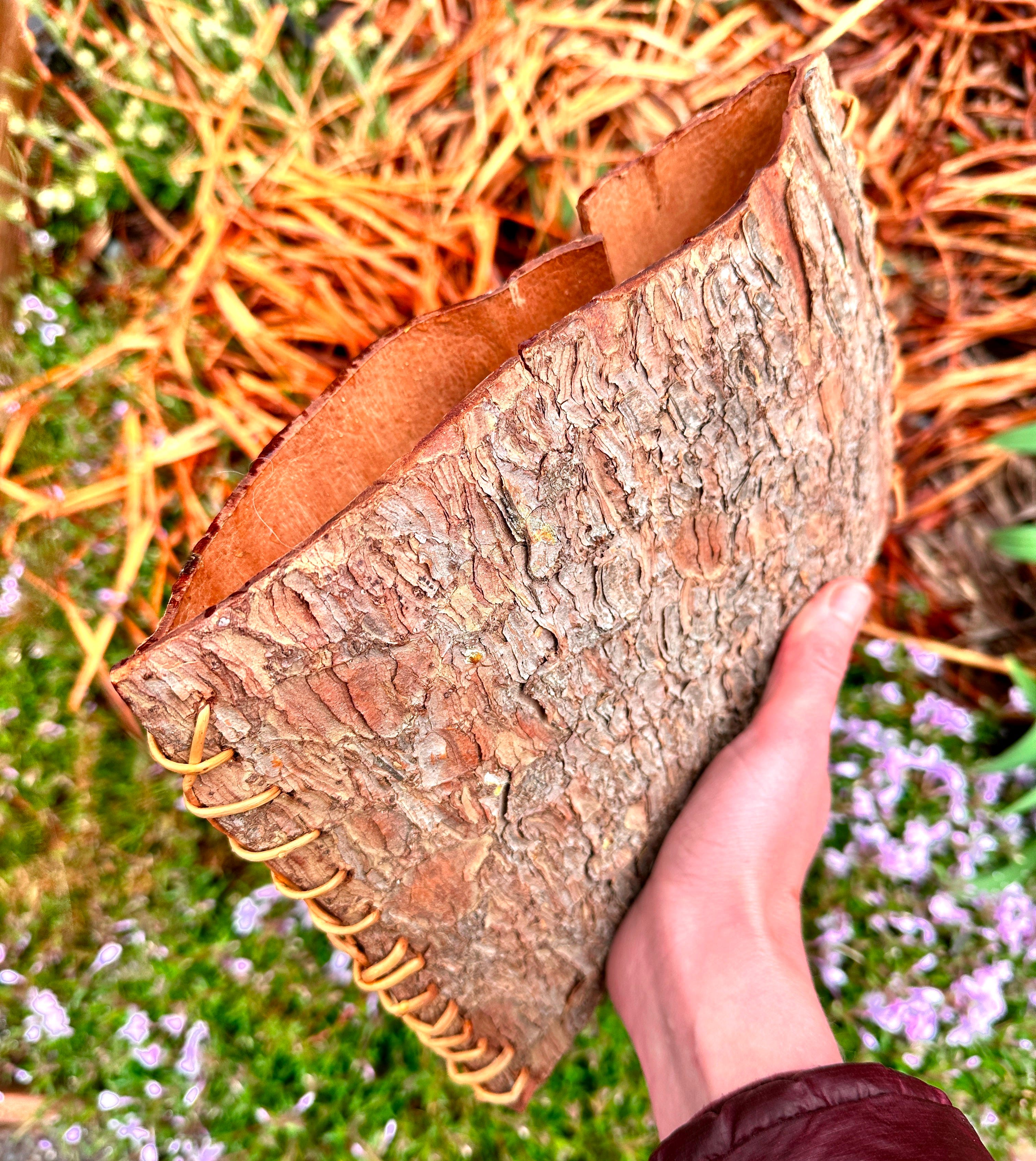
A simple fold to make an envelope of bark. We punched holes with improvised awls, roofing nails from my coworker’s truck.
Nothing about the work yielded easily. The bark clung to the tree. Wrists twisting, pushing the nail, hoping the bark wouldn’t crack. Then coaxing roots through our makeshift holes. Nothing could be rushed.
Years of practice taught me that a basket is a patient accumulation of crossings, tension, and return. So, I’ve learned, is skill.
It is a ritual of belief: that an idea of a basket can take form in my hands until I, too, am slowly shaped into a vessel for what the work has given me.
❈
My ceramics teacher in university used to tell us that a pot is not the clay, but the void inside.
Its meaning lives in the open space made useful by the labor of shaping. Without that interior, it is only a lump. The clay matters, of course, but only because it has been worked into a form that can hold water, grain, flowers, light.
The making creates capacity.
That idea can extend to a person. Craft hollows and shapes us, asking for patience, attention, humility, and repetition. Over time, those practices make an interior space within us: a capacity to hold frustration, beauty, uncertainty, grief, wonder, and gift. The work of the hands is also the work of the soul, a practice that asks us to become the hollow bone.
Teaching is the most difficult craft I know. Again and again, I am asked to respond in devotion for the student in front of me. Through fatigue, burnout, and overwhelm, I am asked to find patience; to keep my aperture of perception wide enough to meet the moment; to keep the heart open beyond ego, beyond defensiveness, beyond the small tyrannies of the self.
I don’t say this because I am altruistic by nature. I am not. But I am unwilling to leave the work because I like the challenge. I like to make my prayers with blood, sweat, and tears. It pushes me to be more spacious than I feel, more patient than I want to be, more willing to hold what my student is carrying on their own. It asks me, in other words, to become a vessel.
To become a vessel is not to be emptied of self, but opened wide enough to hold more than the self alone.
Basketry requires a learned tension in my hands and teaching demands that same tension. The materials yield to a certain kind of attention. If one knows how to listen, they bend and fold to the process.
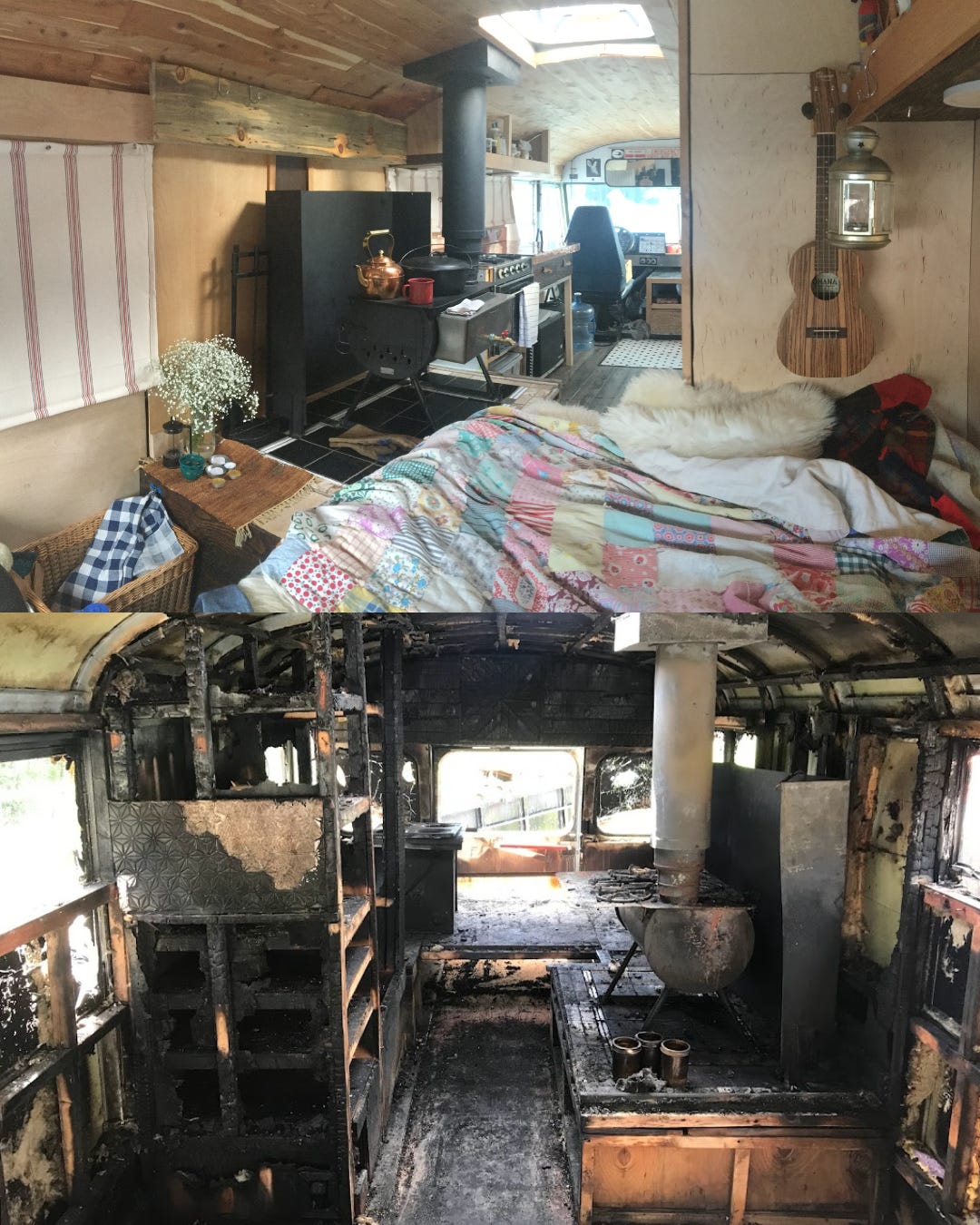
After that first lesson in spruce bark, the years cycled through tents and rentals, seasonal work and scraping by, my life packed and unpacked in the back corners of borrowed rooms. For all that movement, I never let go of my craft supplies. I refused. I built out a school bus to make it easier. One summer evening it burned down. My art, my instruments, my books and journals, reduced to ash.
About a month later, I started a new full-time public school job while attending an online certification program in the evenings. With PTSD already in the mix, and a couple of medical crises folded in, it was a brutal combination. Teaching is a profession that burns through people, and for a time it nearly crushed my spirit.
In the springtime, I haunted logging roads for fallen trees, searching for bark to make my baskets. No grandmother taught me how to cut into a living tree. YouTube cannot replace her, and I have never been able to gather the dignity for it. Instead, I bear witness to the slash.
I think there are many small deaths in life: exhaustion, disillusionment, disappointment, the narrowing of the spirit under too much pressure, the slow erosion of faith. Life cuts to the quick. Seasons when my passion severed from soft earth, collapsed and dried out. The trees I found along those roads bore wounds in their bark. They had been taken by wind, by logging, by time. Some stood half dead, alone; their roots once protected by forest now exposed to a barren hillside. Some lay open to the weather, their bark already tightening.
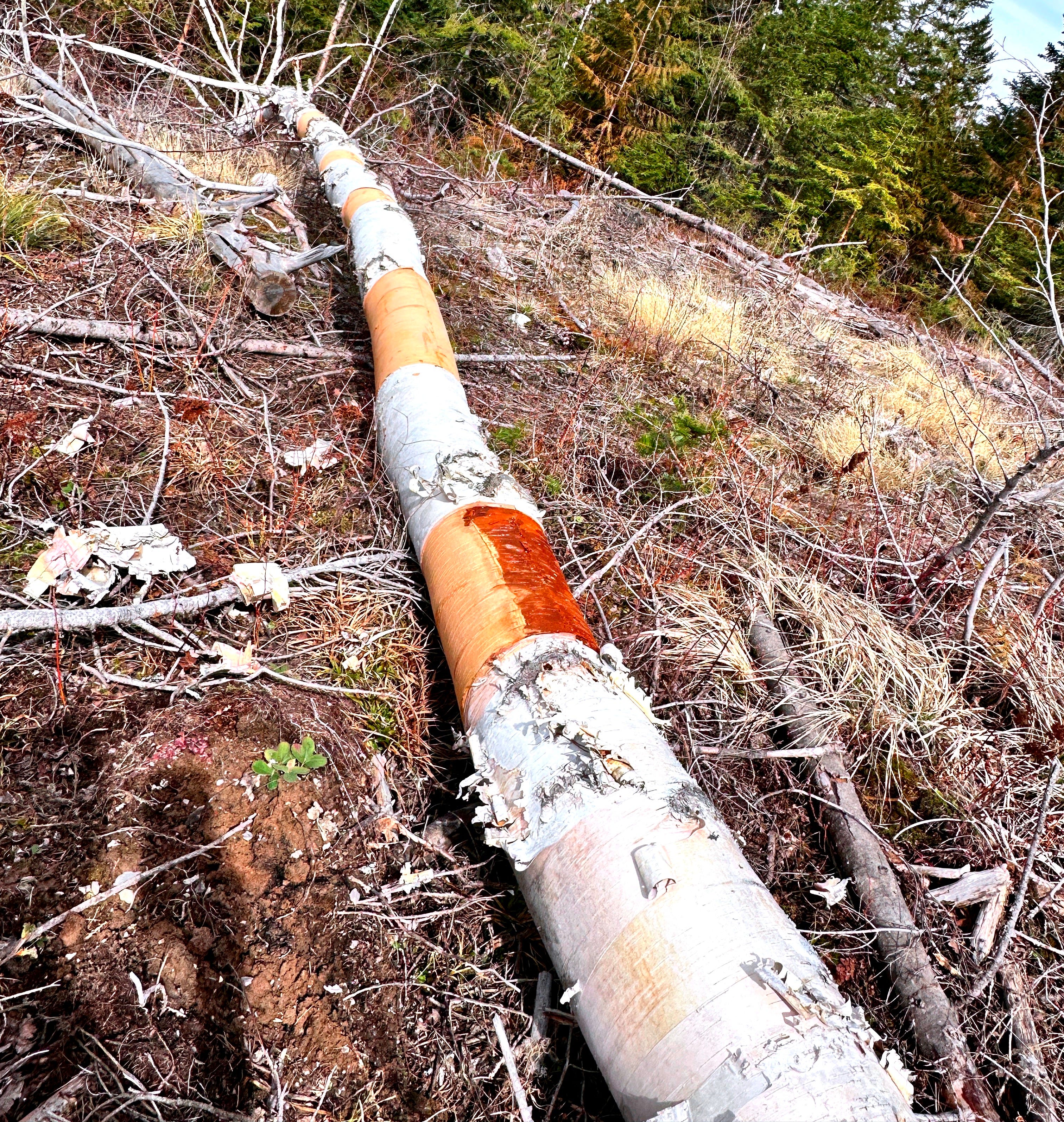
Not every tree has good bark for weaving, but I learned how to straighten lengths into cut strips. I taught myself how to weave them in patterns.
❈
A friend texted me a couple of weeks ago about fallen birch trees he thought I’d want to see. We harvested what we could, though the bark had been weathered longer than expected. After he left, I wandered the forest alone.
That evening I couldn’t find downed birch, but I noticed fallen spruce. For years I tried to harvest spruce bark, but to no avail. Each tree seemed to have fallen at least a season before I found it, the bark too dry and stubborn to remove. I tried tree after tree as the sun dipped behind the canyon walls, the hatchet handle growing sticky with resin and dirt in my hands.
I gave up, ready to eat dinner.
Then, on the drive home, I found another stand blown over. I labored long and steadfast, determined to finally harvest bark for a basket I’d dreamed of years ago. The first piece stuck and cracked on one side, the second, a small strip of bark that also stuck and broke. In my last chance, tuned to the meticulous motions of a rocking hatchet blade, I wedged my fingers just enough to glean a large piece of bark.
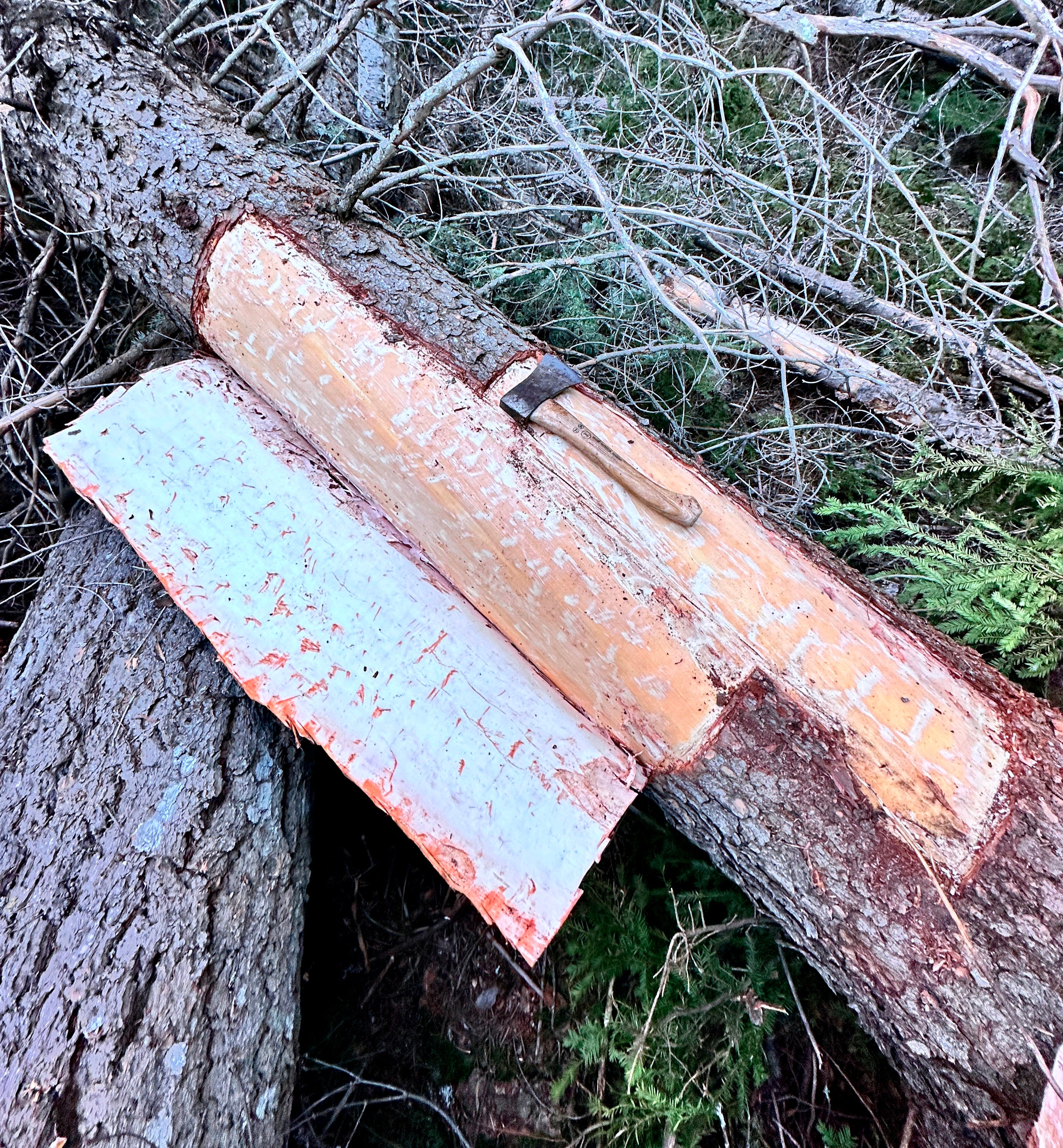
Dusk settled heavy on the evening like silt in a lake bed. Dizzy from concentration, I looked up and into the dark tangle of branches. This is where bears den. Gratitude came first, then caution. Even fallen, the trees were still making shelter. In the twilight I half expected a grizzly to emerge. I left the forest balancing on logs, hovering above the chaos of wind thrown trees.
A dinner for one was served on the kitchen floor that night, spreading paper grocery bags out to make a pattern. By midnight I cut the bark to form.
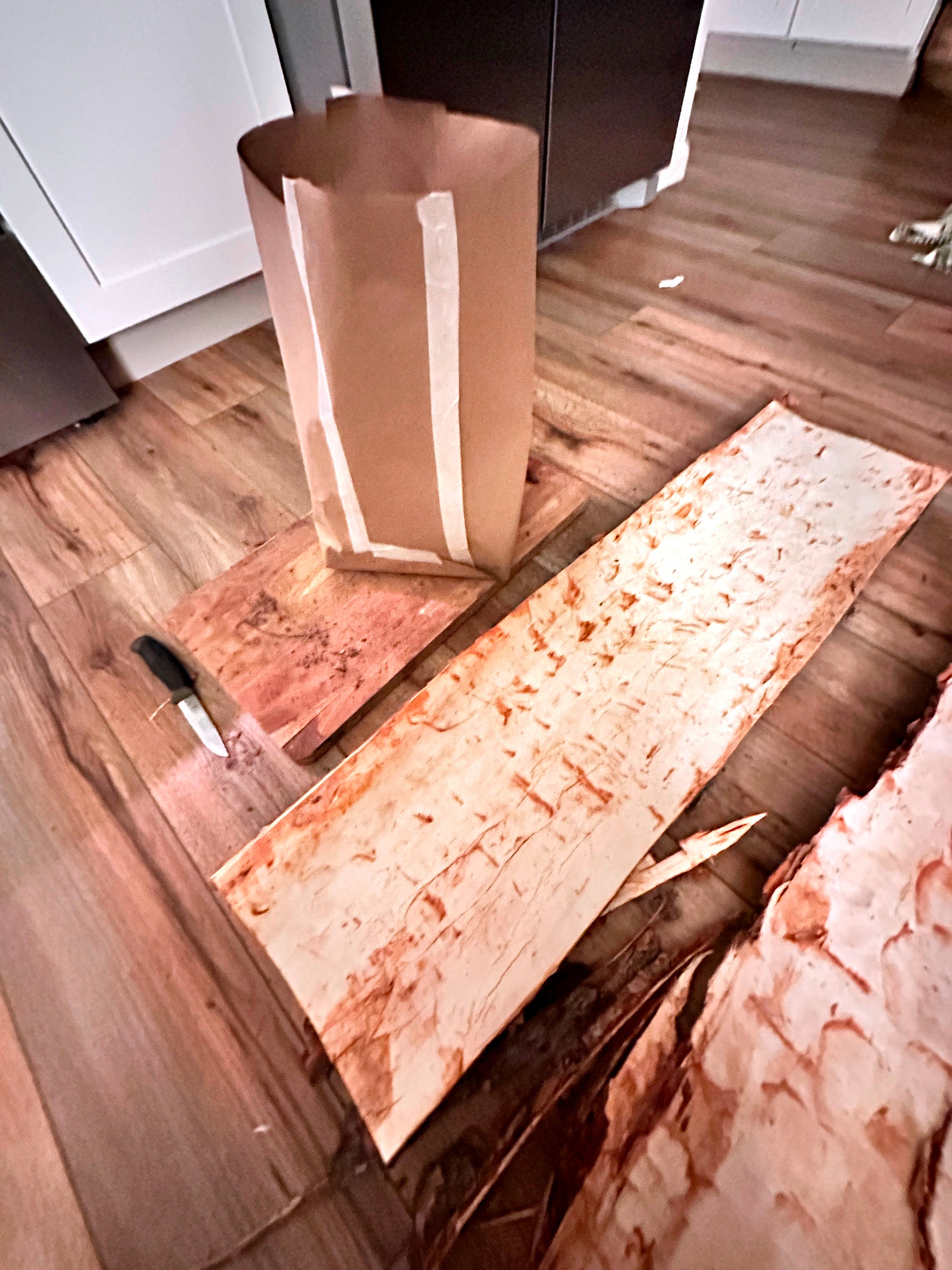
Spruce cannot be folded and stitched after it dries. No one told me this, but my instinct understood that re-hydration would not restore the pliability of the fresh bark. In basketry, the best way to know is by experience.
The weekend dwindled like a candlewick. I burned at both ends weaving and stitching strips of birch for panels. On Friday I scraped, cleaned and cut birch bark into strips. On Sunday I returned to a birch on Crane Mountain to glean anything I could for the second panel. By Monday afternoon the sugars in the spruce bark began to ferment.
It was then, or lose it.
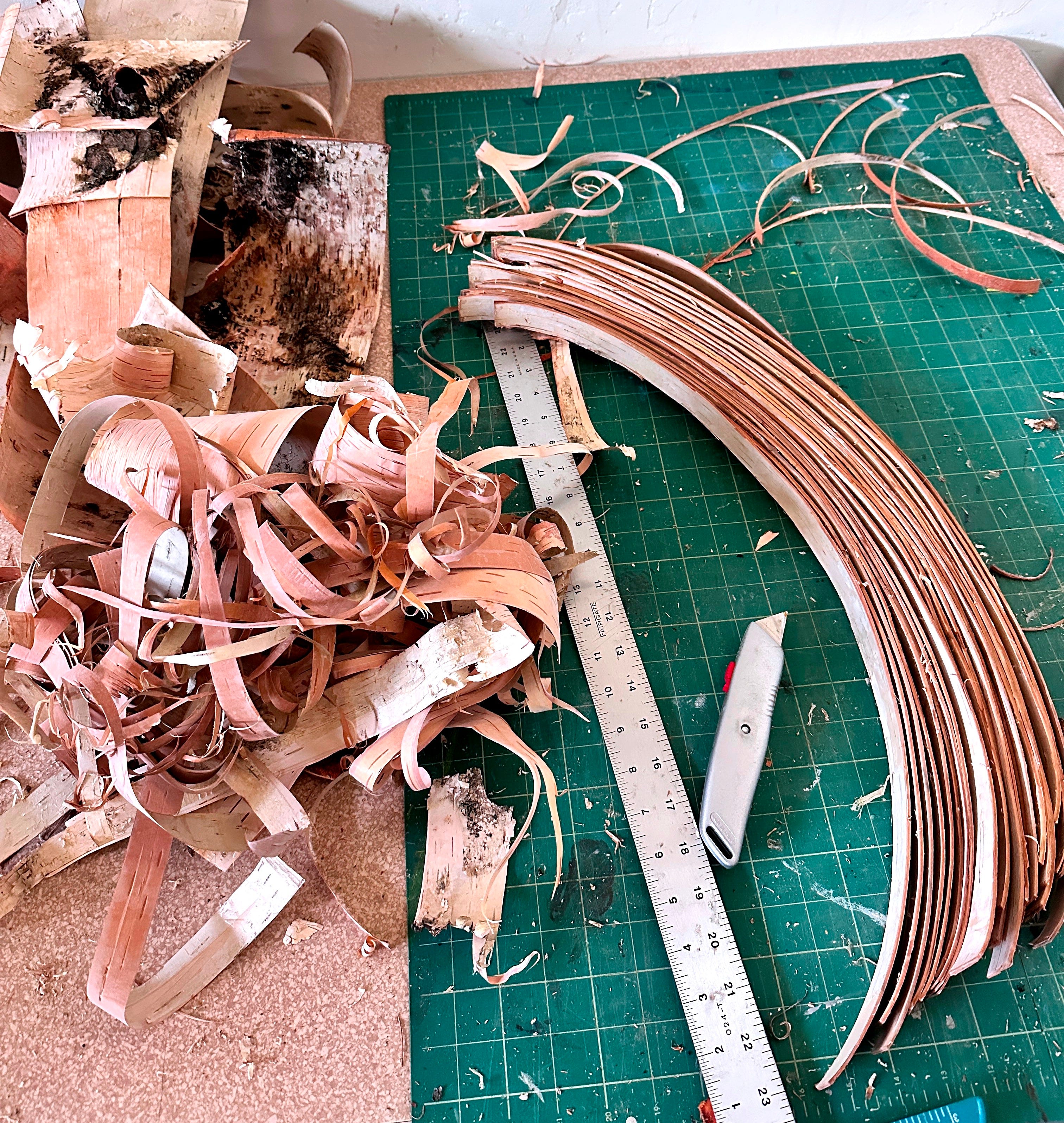
I sifted through a box of cedar root wound in loose spools. Those, too, had come from Crane Mountain, from trees now stacked high along the dirt road. I soaked them in water to a particular pliability.
The clock turned on the cusp of early evening. The kids returned home and I spread out on the table of the ceramics room. With bated breath, I punched the first holes with my basket awl. There’s no way to measure at that point. The more I flexed the spruce bark, the more prone to cracking and tears. I had to trust the makeshift pattern I taped together on the kitchen floor, and my movements needed precision.
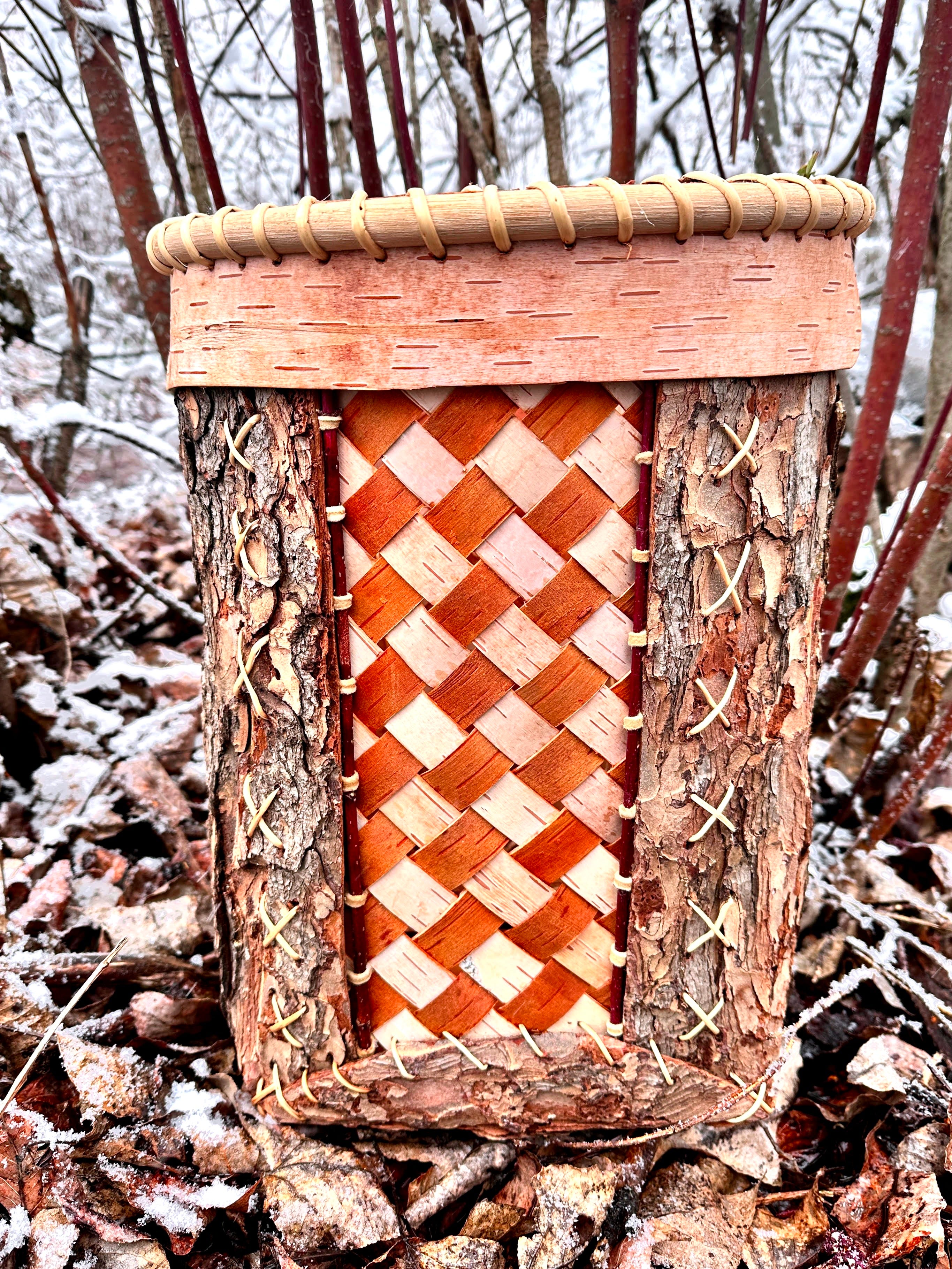
I began stitching. More like pleading, actually. Four layers of bark, one from a spruce more than a hundred years old. The smell of her heady resin filled the room. The birch proved most difficult. The spruce maintained her soft and spongy sweetness and as I stitched her I could feel my own tender heart.
I twisted the awl with as much patience as I could muster. Push too hard, the bark could crack and I would lose my stitching panel. So much work and effort could be lost to a careless mistake. I used damp rags to keep the roots wet. Each time a root finally pushed through that impossible hole it felt like a marvel. Their blunt faces found my pinching fingers. They behave like they would in the ground, their intelligence winding them through duff and stones, impressive in their strength and flexibility.
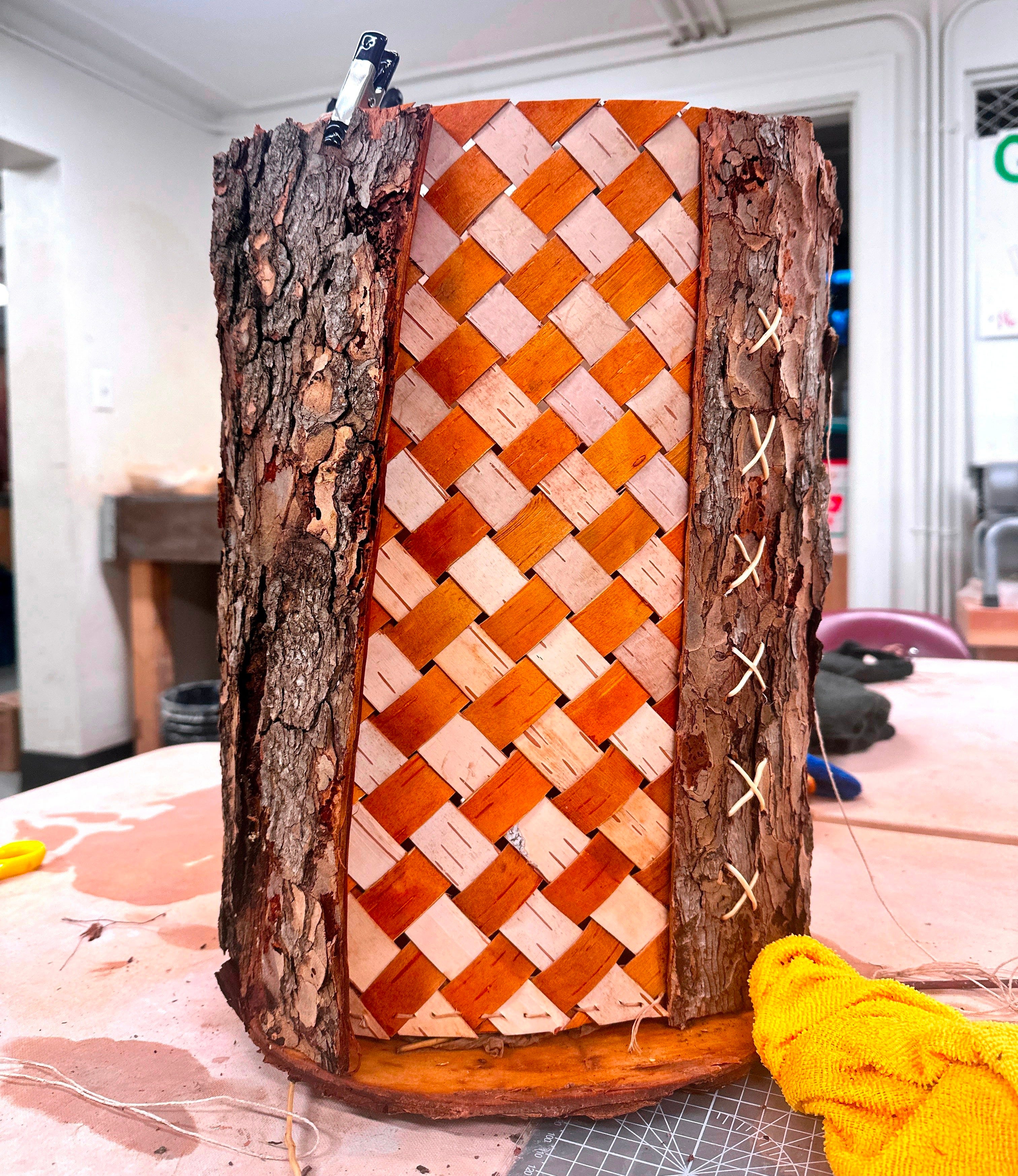
At least an hour went into each stitched panel. The janitor came through and asked what I was doing. In the middle of explaining, I broke a root. By ten o’clock, the column of the basket stood before me. By eleven, the janitor returned to wish me goodnight. Hours passed in the crisscrossing of roots. Teaching the next day would be punishing.
The next day I soaked the rim in the spare sink in my classroom. After work I stitched it into place.
❈
I do not entirely understand why I do this work. Why I bump along the potholes and ruts of logging roads, why I stay up too late stitching roots through stubborn layers, why some part of me keeps returning to the difficulty. I only know that when a basket finally comes into form, it surprises me every time. It stands there with a life I could not have predicted, improbable and tender as a living thing.
In the tension of stitching roots through bark, I am opened into a vessel. I am gathered back to myself through the work of my hands.
Our lives are built in this way, in a thousand crossings that, somehow, hold.
Reflections on birch trees:

The Woman Who Married a Bear: Mytho-poesis and Wildcrafting Ethics

“I’ve heard the bears aren’t asleep yet.” I stand at the window, watching an unseasonable deluge of rain pour into the swelling Swan River. The snow that sloughed off the roof has already pooled into puddles. The snow pack dwindles up the mountainside toward seven thousand feet.
Beautiful work and words! Reminds me of Ursula Le Guin's Carrier Bag theory.
"To become a vessel is not to be emptied of self, but opened wide enough to hold more than the self alone." I love this, Lena. There is so much writing out there advising people - particularly women - not to carry others, as it leaves us depleted and prone to burnout. But many of us want to live in a world where we do support each other. Your image of the vessel is a beautiful map for how to keep hold of ourselves even as we make space for others.