
What if our deepest ecological role isn’t to consume but to decompose?
I once studied with a teacher, Don Elzer -of the Wildcraft Forest School, in Lumby, British Columbia. I respect his teachings deeply, and if you would like to learn more, here is the link to his website: http://www.wildcraftforest.com/ForestSchool.html
In an off comment, Don admitted he really didn’t associate with mushrooms. I was floored. How can you not like mushrooms? We humans are totally obsessed. I’ve chased kids through the woods trying to wrangle them back from a mushroom hunt. I’ve lost myself in the woods looking for them. Mushrooms are everywhere in pop culture (and in my classroom! the kids’ art is full of them)...in later years I would even have an Amanita muscaria tattooed on my arm.
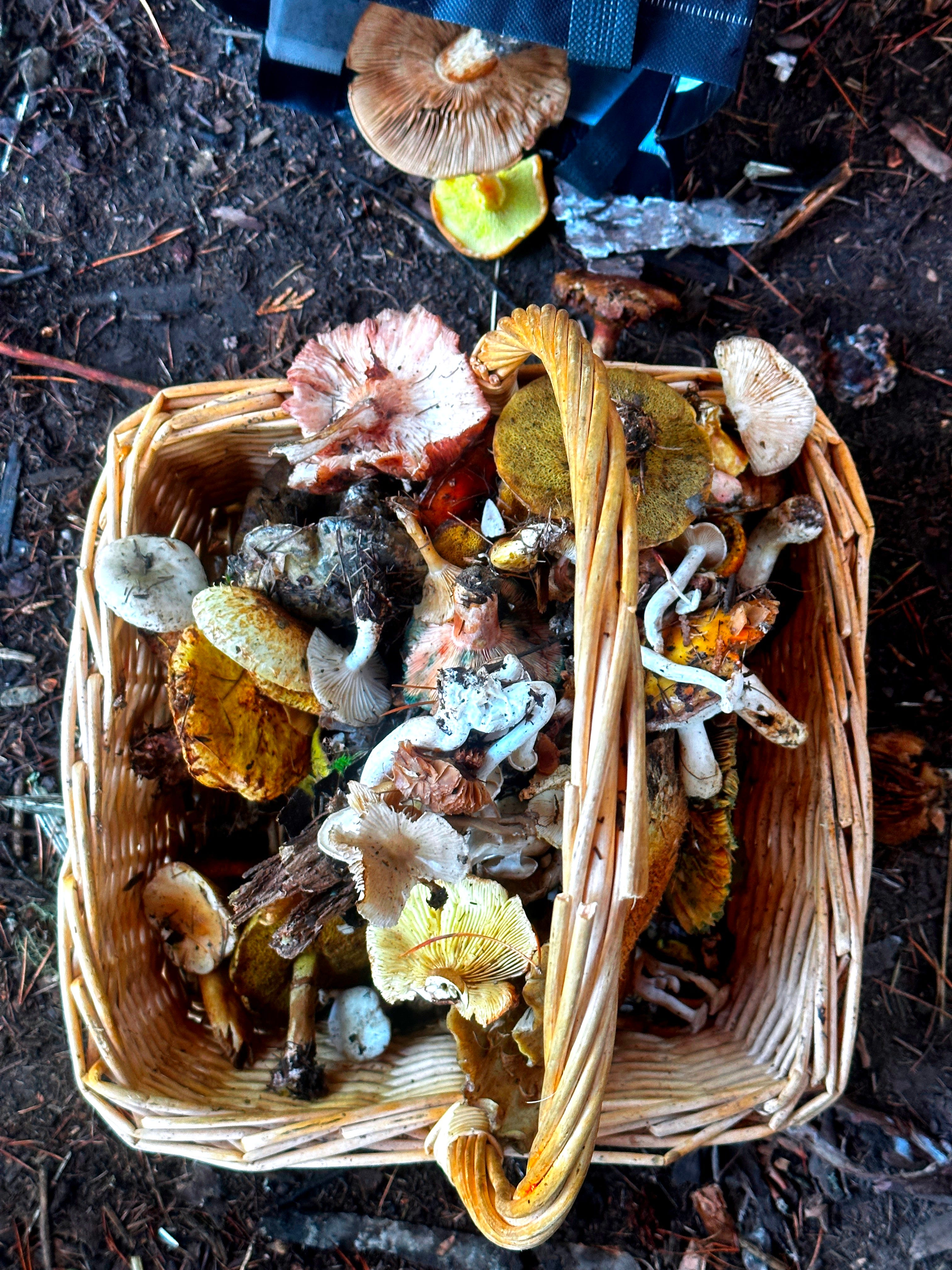
His reason? They are decomposers. They decompose through digestion and then consume. He explained in our modern world, our recent obsession with mushrooms is a symptom of a colonial culture that is rotting from the inside out. It was a powerful argument; a kind of sticky mushroom slime that permeates your soul.
It stuck to me. In trying to wipe off the slime I decided to embrace it instead. What if we re-framed our own biological role as humans in our ecosystems? What if our greatest strength as humans are not as biological consumers, but as decomposers?
Let me break it down:
Not as rot or fungus, not as worm or mold... but as hands that disassemble with care. As hearts that offer back what we’ve taken. Decomposers are organisms that break down what has died and return its nutrients to the environment. It’s the dispersal of resources that is so vital for our ecosystems, and decomposers are the crux of that process.
When I lived in Condon, Montana, I would hang my hunted deer for about a week in cold temperatures. During that time, I’d cape the deer and carry the hide into the adjacent woods to flesh and clean it in preparation for tanning. Under the shelter of spruce trees, chickadees would flock to feast on the bits of fat I scraped away. I’ve learned that this hardy little bird can barely find enough calories to survive a winter’s day. In the late November fall that deer fat provides vital sustenance.
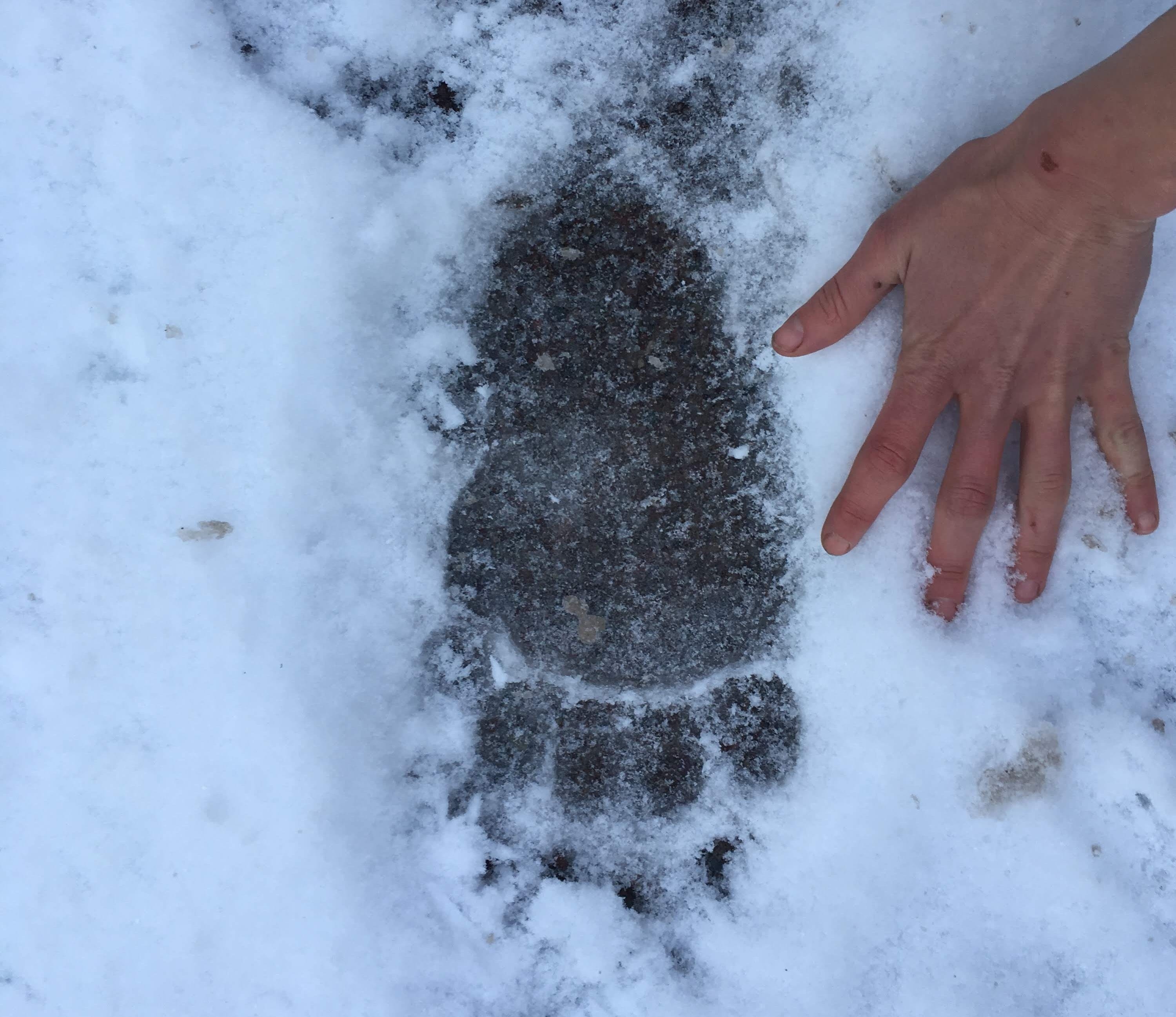
Our close brother, the bear, also feasts before the long winter famine. No matter where I’ve hunted in Montana, the gut piles we leave behind are gone within a couple of days—often overnight. I’ve wondered what the human-bear relationship might have looked like before colonization. While information is scarce, I imagine the buffalo jumps and the richness of carcass left behind for the roaming prairie grizzly bear.
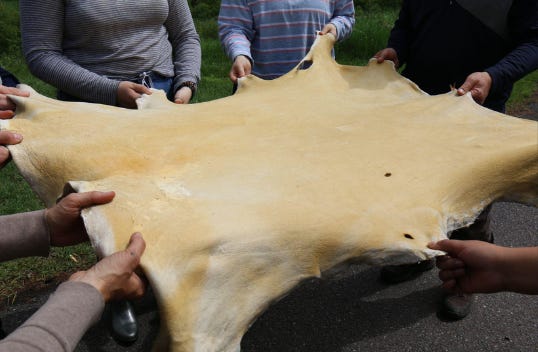
When I tan hides with others—scraping, stretching, smoking—our role as decomposers becomes a cultural act. Hides are the oldest human textile on earth and one of the most durable textiles. In hide tanning we are caretakers of a cycle. Each tendon pulled, each bit of grain scraped away, reminds me that decomposition is creative. It asks us to notice, to respond, to handle the leftovers of life with grace.
We break what was whole and give its pieces to the world again: bones become tools, fat melts into tallow, organs feed the pot, the dogs, the bears. Scraps nourish the soil. Even the hide finds new shape in our hands.
To take on the role of a decomposer is a choice, a radical act of participation. In a time when human systems often disrupt, extract, and discard, this role offers a different way of going about it—one grounded in reciprocity, resourcefulness, and regeneration. Choosing to give back, to break down, to redistribute, is a form of resistance.
I recently found a fantastic article titled The Art of Dying:Notes on Collapse and Transition, by Julian Norris. The article explores the restructuring of societies in the face of apocalyptic collapse…because yes, we’ve been here before as a species. Are our systems truly rotting from the inside out like Don said?
The “end times” we cry about won’t be a monolithic, catastrophic end-all be-all like the movies would like us to believe. Civilizational collapse is multi-generational and happens in multiple phases. It’s dynamic, complex and multi-layered. Norris defines different kinds of collapse even- Dissapative and Regenerative. I believe we can use our role of decomposers to restructure these times into a regenerative collapse.

Norris defines Regenerative collapse as “complexity- transforming, pattern shifting…the system sheds unsustainable complexity to reorganize at a different scale or with new emergent properties.”
Imagine your neighborhood has raised enough sheep for each household to have sustenance for one dinner a week for the coming year. You gather, singing, laughing, sharing stories, celebrating the harvest and sustained life these animals have gifted your families. Together you butcher and put away the steaks in a weekend. While you’re packing the meat, another family member or friend is washing the hides, and stringing them up to soften by your hearth as the winter draws in.
As SNAP benefits are canceled and people go hungry, we already see this redistribution happening in profound ways. This year I’ve cleaned 4 hides that came from hunted deer donated to our local food bank.
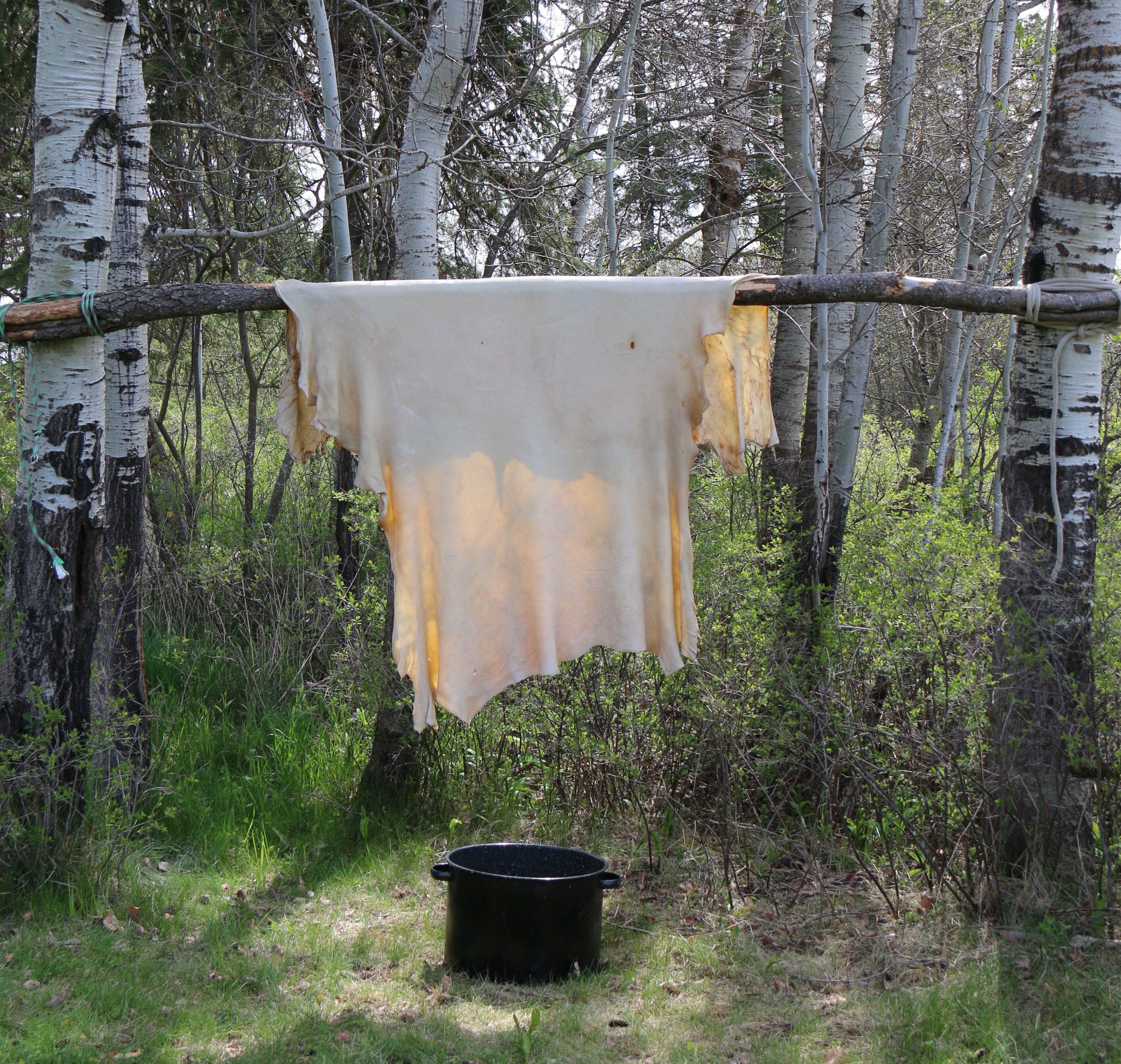
Decomposers are essential to ecosystem health. Without them, nutrients stall, cycles break, and waste accumulates. The same is true in human systems. When we tan hides, render tallow, compost organs, or return scraps to the soil, we’re restoring balance. We’re reducing waste, deepening local knowledge, and building resilience into our lives and landscapes.
To live like a decomposer is to close loops. To turn excess into offering. To ask: How can I return this in a good way?
As humans, we’ve always had a role in that. It’s what our ancestors did with patience and purpose. After harvesting life, we return it, piece by piece, in gratitude.
Decomposition is emotional, spiritual, and cultural. Humans have long held rituals around it: burial practices, ceremonies around death, composting, even food preservation through fermentation. These are all ways we consciously partner with decay.
Like any skill, decomposition takes practice. I wasn’t born knowing how to scrape a hide, render tallow, or compost organs. I’m disconnected from local, tribal-like organizing and economies based in barter. But these are skills our ancestors honed, and they’re worth relearning. Not just for survival, but for belonging.
The more I learn about ancestral skills, the more I see the symbiotic relationships between humans and decay. Fermentation preserves food, the stinkiest deer hide (within reason) turns into the softest buckskin, burying pottery clay ages it to perfection, indigo has to decay to release the vibrant blue hue. We could even say that mushrooms contributed to our evolution as a species. To practice decay in our lives is not only to participate with our environment and keep resources flowing, but to continue the skills and remember what it means to be human on earth.
In these times we are seeing historical colonial systems teetering on their own demise. Naomi Klein wrote an excellent piece on “End Times Fascism“ and it’s an insightful look at the multiple movements coalescing around the end of the world: the rapture, leaving earth for mars, the sixth great mass extinction. Here in the U.S. we are watching our systems be challenged in unprecedented ways.
I am reminded of one of the lessons I learned in Chile. During the upheaval Pinochet’s dictatorship people would gather in the streets with Ollas Communes (Communal pots). Like soup kitchens and Black Panthers. Like Food Not Bombs and the Occupy Movement. All of these carry the sense of decomposition: take the excess and distribute to the network.
To decompose within our colonial systems is to notice where excess, waste, or concentration of power sits—and to return it, carefully, to the networks that need it most. Land holdings can be decomposed from private accumulation and returned through rematriation, land trusts, or shared community gardens. Knowledge, once hoarded within institutions, can flow freely through mentorship, skill shares, and inter-generational teaching. Food, wealth, and material resources all hold the same potential: when we redistribute them, we allow cycles to continue instead of stagnating under systems built to extract and contain.
At Making Place Montana, a community tool library, hammers, drills, saws, and more circulate through shared hands—breaking down the system of ownership that demands each person purchase everything themselves. By lending, borrowing, and teaching each other how to use the tools, the library supports shared abundance.
Seeds, too, can embody this practice. At Free the Seeds, hosted by Land to Hand Montana, community members spend the year donating, cleaning, and packaging seeds, culminating in a massive gathering and skill share. Knowledge and labor are pooled and redistributed, ensuring that plants (and the skills to grow them) reach new hands, new gardens, and new networks of care.
These gatherings are part of a larger ecosystem of cultural decomposition. Across the country, events like Rabbitstick, Wintercount, Between the Rivers, Saskatoon, Acorn, Elkhorn and so many more, bring people together to share skills, stories, and resources. At these events, nothing is hoarded—every lesson, tool, and craft is broken down and scattered, building networks of care, resilience, and creativity. I want to give a big shout out to Sea Stone Gathering, who has taken these gatherings a step further by raising both funds for, and awareness of, the Chinook Nation’s journey towards federal tribal recognition. Sea Stone is just starting out and leading these gatherings in so many ways.
Community fairs like Barter Fair or the Okanogan Family Faire demonstrates a barter economy. At this gathering, goods, skills, and labor are exchanged without money, creating a system that values reciprocity over profit. Surplus—from handmade goods to food, tools, or crafts—is broken down into shareable pieces and redistributed to others who can use them.
In these circles, excess becomes access. Knowledge becomes nourishment. Skills become networks of care. Through this practice, we begin to see how humans can belong not by consuming, but by returning, sharing, and sustaining the cycles we are part of. Decomposition becomes a radical form of stewardship, a quiet resistance, and a way to belong to each other and the land.
When we honor decomposition in our bodies, minds, and circles, we stop pretending everything must be preserved or pristine. We learn to trust in cycles. We remember that nothing truly disappears, everything becomes something else, and it is our true role as decomposers that allows for this transformation.
In what ways do you see yourself or our community acting as decomposers—breaking down old systems, ideas, or materials to make way for new growth?
This is a lovely post, thankyou. Couldn't agree more.
"The more I learn about ancestral skills, the more I see the symbiotic relationships between humans and decay. Fermentation preserves food, the stinkiest deer hide (within reason) turns into the softest buckskin, burying pottery clay ages it to perfection, indigo has to decay to release the vibrant blue hue. We could even say that mushrooms contributed to our evolution as a species. To practice decay in our lives is not only to participate with our environment and keep resources flowing, but to continue the skills and remember what it means to be human on earth."
All of this. Overculture demands everything must happen instantly. That the product must arrive immediately and that waste material just vanishes, who cares where. These habits, normalized within my lifetime, are astonishingly out of sync with rhythms of life. Millions of years worth of plant decay became the fossil fuels we are blazing through.